The Ultimate Guide to Scaling Micro-Influencer Campaigns in 2026
How Australian brands run 50+ micro-influencer campaigns without burning out a marketing team. Operational playbook, AUD benchmarks, AANA and ACCC compliance.
By Donkey Dan, edited by Dr Brent Coker

You can’t scale a micro-influencer programme by working harder. You scale it by changing what gets manual attention. The brands running 50, 80, 100 concurrent creators in Australia aren’t doing it with bigger spreadsheets — they’re doing it by removing decisions from the campaign loop. Fixed pricing replaces negotiation. Escrow replaces invoicing. A single brief replaces fifty email threads. This guide is the playbook we wrote for ourselves while building Mega Donkey — and the one we wish more Australian marketing teams had before they hit the wall at 20 creators.
Why scaling micro-influencer campaigns matters in 2026
The Australian influencer market is on track to crack AU$1 billion in annual spend during 2026, according to AiMCO and IAB Australia, and the share going to micro and nano creators is growing faster than any other tier. The strongest peer-reviewed field study on the topic — Beichert, Bayerl, Goldenberg and Lanz (2024) in the Journal of Marketing — analysed 2,808 Instagram discount codes across €17 million in revenue and 1,698 influencers, and found nano-creators (around 1,000 followers) generate roughly five times more revenue per follower than macro accounts and deliver about 20× ROI on a typical AU$50–$80 promotional post.
But none of that helps if you can’t operationalise it. Authentic content from 50 micro-creators is only a competitive advantage if you can actually run the programme — and it starts with finding the right 50 in the first place. Running a 50-creator programme is a fundamentally different job from running one celebrity deal. That’s the gap this guide closes.
What “scaling micro-influencer campaigns” actually means
Scaling a programme doesn’t mean cloning the same campaign template more times. It means treating influencer marketing as a content supply chain rather than a series of bespoke negotiations. The unit of work shifts from “one post” to “one cohort” — typically 30 to 100 creators activated against the same brief in the same window. The marketing manager’s role shifts from negotiation and chasing to brief design, creator selection, and post-campaign analysis; the grunt work moves to software. And the economics shift: cost per asset drops sharply because there’s no agency mark-up, no per-creator negotiation cycle, and the same brief is amortised across the cohort.
This shift is the whole reason the Blanket Campaign thesis works. Volume of authentic voices beats one celebrity endorsement, but only when volume doesn’t cost you twenty hours per creator to run. The rest of this guide is the operational answer to that.
Why micro beats macro: the Australian maths
We’ve written elsewhere about why micro-influencing is increasing and the trust deficit that follows mega-influencers. The short version is that the engagement and conversion gap is wider in Australia than the global averages suggest.
Sprout Social’s 2025 Australian benchmark (drawing on Statista Influencer Outlook data) puts the picture like this:
- Nano-creators (1k–10k) on Instagram in Australia: ~12.6% average engagement.
- Nano-creators on TikTok in Australia: up to ~18% on the right niches.
- Micro-creators (10k–100k): ~3–5% engagement, well above the global macro benchmark of under 2%.
- Macro-creators (over 1 million): typically under 2%, often closer to 1%.
HypeAuditor’s State of Influencer Marketing also confirms that close to 80% of Australian Instagram creators sit in the nano and micro tiers. That isn’t a fringe segment — it is the supply curve.
On price, the same Sprout Social/Statista benchmark puts an Australian micro-influencer (10k–100k) somewhere between AU$39 and AU$1,965 per post. The range is wide because deliverable type, exclusivity, niche, and platform all move the number more than follower count. We dig into the methodology in a forthcoming companion piece on Australian micro-influencer rates — but the headline is that the rate-per-follower fallacy is dead. Pay per content unit and per performance bonus, and the spread tightens.
The maths argument matters because brand teams keep getting talked into one expensive macro deal on the basis of “reach.” Reach without trust converts at noise levels. Our point of view, backed by both peer-reviewed work and the platform-level data we observe at Mega Donkey, is that 50 micro-creators outperform one macro for almost every Australian DTC, food and beverage, beauty, and fitness brand we’ve worked with. We make the case in detail in Why Your Shopify Store Needs 50 Micro-Influencers, Not 1 Celebrity.
The 15–20 creator wall: where in-house programmes break
This is the proprietary insight we keep coming back to, because we’ve seen it on both sides — as a marketplace operator and across brands we onboard.
The operational cliff sits between 15 and 20 concurrent creators. Below it, a competent social media manager with Notion, a shared spreadsheet, and a personal Gmail can muddle through. Above it, the load goes non-linear. There are roughly fifteen distinct touchpoints per creator across a campaign life cycle — brief, contract, address confirmation, shipment, content draft, revisions, post verification, payment, reporting — so a 50-creator cohort means 750 touchpoints in a fortnight. No spreadsheet survives that.
What actually fails first is communication. By creator twenty, replies start to slip. By creator thirty, two creators have submitted content you can’t find, one hasn’t received product, and three are asking when payment is coming. The last 10% of the campaign then consumes 90% of the marketing manager’s week.
The diagnostic markers brands describe to us in onboarding calls:
- Average response-to-creator time drifts from same-day to 48 hours.
- First-submission approval rate drops because briefs get less personalised attention.
- Compliance tracking becomes ad-hoc rather than systematic.
- Reporting lags the campaign by weeks, so you can’t course-correct in flight.
This is why we built Mega Donkey around the assumption that scale starts at 15 creators, not at 50. Every feature, from bulk operations to escrow auto-release to one-revision enforcement, exists to push that operational ceiling out by an order of magnitude. We unpack the failure mode in detail in a forthcoming post-mortem (“I Spent 20 Hours Chasing $50 Payments”).
What a 50-creator campaign actually looks like, end to end

Once you’ve decided to run cohorts instead of individual deals, the workflow flattens into a small number of repeatable steps. The canonical version is the subject of a forthcoming companion piece (The 8-Step Autopilot), but here’s the shape at a glance.
| Step | What happens | Where the time goes if you do it manually |
|---|---|---|
| 1. Create | Brand posts campaign brief at a fixed rate | 2–4 hours writing the brief |
| 2. Apply | Creators browse and apply | Days of cold outreach replaced by inbound applications |
| 3. Select | Brand reviews applicants and accepts | Manual vetting, follower checks, audience demographics |
| 4. Pay | Payment charged and held in escrow | Manual invoicing, accounts payable cycle |
| 5. Create | Creator produces content per brief | Endless DM threads chasing drafts |
| 6. Review | Brand approves or requests one revision | Five-round revision spirals |
| 7. Publish | Creator posts to social | Manual link collection across DMs and email |
| 8. Release | Payment auto-releases on verification | Chasing the brand to release funds |
Six of those eight steps are dead time when run manually. Only the brief and the creative review actually need a human’s full attention; the rest is coordination — the part marketing software exists to remove.
The brief decides 80% of the outcome
A bad brief produces fifty pieces of inconsistent content and a revisions queue you can’t process. A good brief produces a wave of on-message creator content and a single approved batch.
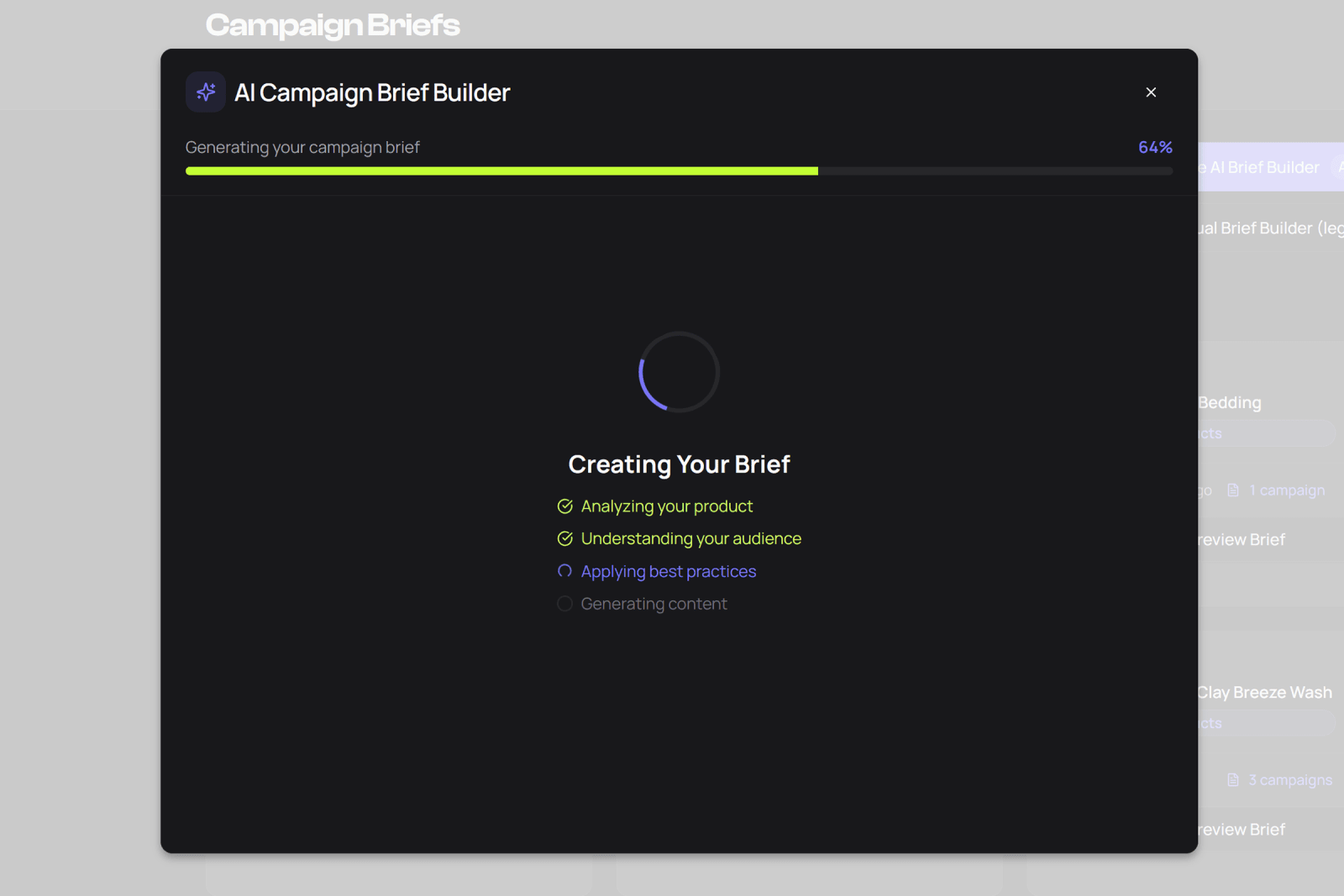
Our AI Brief Builder turns five strategic answers into a complete brief — requirements, key messaging, platform-specific direction, hashtags, restricted terms, tone — in under two minutes. Adoption among brands on the Scale plan sits at 87%, which tells you the bottleneck was never writing skill, it was time. Two structural rules separate good cohort briefs from bad:
- Frame the what and the why, leave the how to the creator. Over-scripted briefs measurably reduce engagement, particularly for unfamiliar brands — a finding from Wies, Bleier and Edeling (2023) in the Journal of Marketing that lines up with everything we see in our own approval-rate data.
- Never pretend studio production is the goal. UGC outperforms polished brand-shot content on engagement and on paid amplification. The argument is also the subject of Authentic Beats Polished: How to Keep Influencer Content Real, and a forthcoming piece on UGC versus studio content.
If you write the brief once and it survives 50 creators producing 50 distinct interpretations, your campaign was set up correctly.
The hidden lever most brands miss: payment infrastructure

Almost every guide to “scaling influencer marketing” treats payment as an afterthought. We treat it as the operational lever that decides whether a 50-creator programme is feasible at all — and the data backs that view. Tipalti and Lumanu reported in 2025 that around 87% of creators experience late payments and 74% stop working with brands they feel undervalued by. At Mega Donkey we’ve watched both sides of that dynamic, and the structural answer is the same regardless of which side you’re on: take the payment moment out of human hands.
Three mechanics matter. None of them are exotic, but very few in-house programmes implement all three.
- Escrow on acceptance. Funds move into a held account the moment the brand accepts the creator’s application — before any content is produced. The creator sees the money is there. The brand sees the money is parked. Neither party negotiates while uncertain about the other’s intent.
- Verification before release. Funds release only after the live post URL is submitted and engagement metrics are verified. If a creator ghosts, the money returns to the brand. This collapses the single biggest brand-side risk in Australian micro-influencer marketing — paying for a post you never receive.
- Auto-release on a clock. If the brand fails to release manually within a defined window (we use ten days post-verification), the system releases payment automatically. That guarantees creators always get paid for delivered work, which is the single biggest creator-side risk.
The reason this is a scaling lever, not just a fairness mechanism, is that it removes the manager’s most time-consuming individual decision (when do I pay this person?) from every single creator relationship. At 50 creators, that’s the difference between two hours of accounts-payable work per week and zero.
For brand-side readers, the takeaway is direct: if your payment infrastructure is “personal Stripe plus a Notion checklist,” you can’t scale past 20 creators safely.
The one-revision rule and why we enforce it at the platform level
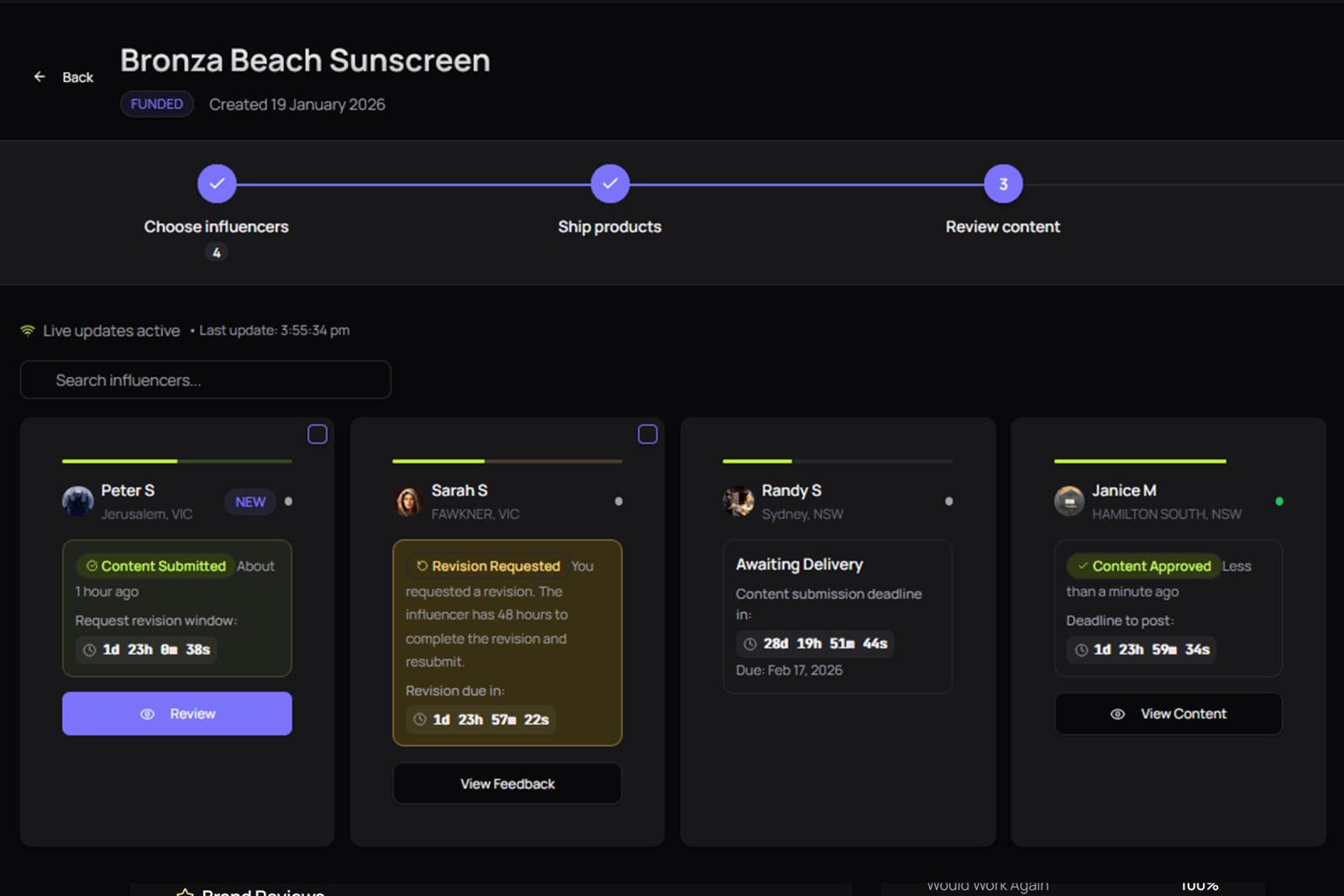
This one is genuinely contrarian, so we’ll defend it directly. Mega Donkey allows brands one structured revision per submission. Not two. Not three. Not “as many as needed.” One.
We made it a hard platform rule because we kept seeing the same failure pattern, and it cuts in both directions. From the brand side, unlimited revisions create scope creep that destroys cohort timelines — the campaign was meant to launch in fourteen days but landed in five weeks because three creators went four rounds. From the creator side, unlimited revisions train people to under-invest in the first submission because they assume changes are coming anyway. The result is mediocre first drafts, frustrated brands, fatigued creators, and a brand programme that runs at the speed of its slowest revision loop.
A single hard revision flips the incentives. The brief becomes more precise. The first submission gets the creator’s full attention. Feedback is structured (we use preset categories — brand visibility, caption issues, missing hashtags, quality concerns) so the revision is unambiguous rather than a moving target. Disputes route into a separate resolution path with frozen funds rather than perpetual back-and-forth.
A forthcoming companion piece (The One-Revision Rule) makes the brand-side argument in detail; Deal Breakers Brands Notice on Creator Profiles covers the creator-side mirror.
AANA, ACCC, and what the Photobook Shop ruling actually means for you
Australian compliance stopped being theoretical in March 2026. The ACCC issued its first-ever financial penalty against a brand for orchestrating undisclosed influencer endorsements, fining online printing service Photobook Shop a total of AU$39,600 across two infringement notices. The trigger: 107 influencer engagements between August 2024 and September 2025, with value-in-kind goods worth AU$50–AU$400, where the brand’s contract explicitly instructed creators not to disclose the commercial relationship.
That ruling does three things to how Australian brands need to think about scaling.
- Gifted is paid. The AiMCO Guide to Gifting and Ad Disclosure already treated value-in-kind as equivalent to payment. The ACCC has now demonstrated it will enforce that view with cash penalties. The “but it was just a free product” defence is officially dead. We treat this so seriously that gifted-only campaigns aren’t allowed on the platform — every campaign on Mega Donkey carries a real AUD payment.
- The brand is on the hook, not just the creator. ACCC Deputy Chair Catriona Lowe was clear: brands that orchestrate deceptive conduct will be penalised. Outsourcing the disclosure decision to creators doesn’t transfer the liability.
- Disclosure has to be obvious to the ordinary consumer. Vague terminology (“collab”, “partner”, “spon”), buried captions, or “read more” hashtags fail the prominence test. The ACCC’s 2023 sweep found 81% non-compliance across 118 audited Australian influencers — 96% in fashion alone. That’s the baseline regulators are now policing.
For brands running cohorts of 50 creators, this is structural. You cannot eyeball compliance one post at a time when you’ve got dozens going live in the same week. The fix is to build disclosure into the brief and the contract, then verify it at the post-publication step before payment release. A forthcoming AANA disclosure guide will go deeper on the practical mechanics; our trust playbook for brand-side risk covers the wider compliance picture.

One more vertical-specific note. If you sell anything therapeutic — supplements, skincare with active claims, weight management, sexual wellness, sunscreen — the Therapeutic Goods Administration removed over 13,700 unlawful advertisements from social media in FY2024–25, and paid testimonials are banned outright in those categories. Don’t run influencer campaigns in those verticals without specialist compliance review.
Why long-term beats one-off
The one-off campaign treadmill is expensive — every new campaign costs you the discovery work, the contract redlining, the briefing learning curve, and the trust-building all over again. The IPA’s 2025 Effectiveness Databank (220 econometric campaigns across £133 million in spend and 28 markets) finds influencer programmes deliver a 3.35× long-term ROI multiplier that one-off measurement systematically misses. For micro-influencer programmes, this means tiering the roster: a discovery layer of gifted seeding and low-stakes paid first campaigns to identify creators who move metrics, a core ambassador tier of 10–20 retained top performers, and an always-on affiliate tier of performance-linked deals at a wider pool. The practical answer to “we’ve got more money than time” is always to convert the cohort into a programme — the case made in The Two Things You Can’t Fix With a Bigger Budget.
Related reading
These pieces go deeper on the operational mechanics summarised here.
- The Blanket Campaign Thesis — why 100 creators with 1,000 followers beats one creator with 100,000.
- Why Your Shopify Store Needs 50 Micro-Influencers, Not 1 Celebrity — the e-commerce application of the thesis.
- The Un-Influencer (2026) — what AI saturation has done to consumer trust signals.
- Why Micro-Influencing Is on the Rise — the structural and algorithmic forces pushing the segment forward.
- Influencer Marketing for Food & Bev Brands — vertical-specific playbook for one of the highest-conversion AU categories.
- The Two Things You Can’t Fix With a Bigger Budget — ROI proof and audience trust, and why budget alone doesn’t solve either.
- Authentic Beats Polished — keeping creator content from drifting into stilted ad copy.
- Deal Breakers Brands Notice on Creator Profiles — what brands filter out in the application stage.
- Welcome to Mega Donkey — the founding-charter post explaining the marketplace’s purpose.
Coming next — The 8-Step Autopilot (the full workflow walkthrough), Spreadsheet Hell Post-Mortem, Brand Brief Templates That Actually Get Used, The One-Revision Rule, UGC vs Studio Content, and Ad Fatigue Is Killing Your ROAS. We’ll link them back here as they publish.
Frequently asked questions
What does scaling micro-influencer campaigns actually mean?
It means running concurrent, repeatable campaigns with 30 to 100 creators per cohort instead of one-off deals with a single influencer. The unit of work shifts from “a post” to “a programme” — the same brief, brand voice and payment structure applied across many creators in parallel.
How many creators is too many for a spreadsheet?
Across the brands we work with, the wheels start coming off between 15 and 20 concurrent creators. That’s where DM threads, payment chasing and revision loops compound faster than a single coordinator can keep up. Above 20, you’re either hiring a second coordinator or adopting platform tooling.
What engagement rate should I expect from Australian micro-influencers?
Sprout Social’s 2025 Australian benchmark puts nano-creators (1k–10k) on Instagram at around 12.6% engagement, with TikTok nanos reaching as high as 18%. Macro-tier accounts (over 1M followers) typically sit under 2%. The gap is wider in Australia than in the global averages, in part because the Australian creator base skews heavily toward nano and micro tiers.
What should I pay an Australian micro-influencer per post in 2026?
Sprout Social’s 2025 Australian benchmark puts micro-influencer (10k–100k) rates between AU$39 and AU$1,965 per post. Variance is enormous — niche, deliverable type and exclusivity all move the number more than follower count. A forthcoming companion post covers the methodology and our own platform-rate observations.
Do I need to disclose gifted-only campaigns under AANA and ACCC rules?
Yes. The AiMCO Guide to Gifting and Ad Disclosure treats value-in-kind as equivalent to payment, and the ACCC’s first influencer-disclosure fine in March 2026 (Photobook Shop, AU$39,600) was triggered specifically by undisclosed gifted reviews valued at AU$50 to AU$400. The brand was penalised, not the creators. Build disclosure into the brief and verify it at the post-publication step.
How do I stop creators ghosting after I send product?
Two structural fixes work better than chasing: pay through escrow rather than upfront, and only work with creators whose performance history you can verify. Escrow removes the brand’s downside on each individual deal — that’s what makes 50-creator campaigns feasible.
How many revisions should I allow per piece of content?
One. Two rounds is the practical maximum if your brief is genuinely unclear. Anything more and you’ve lost the speed advantage that micro-influencer marketing exists to deliver — and you’ve trained creators to under-invest in their first submission. Mega Donkey enforces a single-revision rule at the platform level for exactly this reason.
Should I build this in-house or hire an agency?
For a single hero campaign with a major launch, an agency makes sense. For repeatable, always-on micro-influencer programmes at 30+ creators per cohort, in-house tooling wins on cost-per-asset and speed. Most Australian brands we onboard are leaving an agency, not a competitor platform.
Where to start
If you’re below 15 creators per campaign, your spreadsheet still works — focus on the brief and the disclosure. If you’re at 15–20, you’re at the wall, and the cost of staying is hidden in your team’s evenings and weekends. Above 20, the question isn’t whether to bring in tooling, it’s how fast.
Mega Donkey’s Starter plan is free and includes the AI Brief Builder, Safety Check, and the campaign marketplace. Run your next cohort on it and see what 50 creators looks like when payment, content review, and compliance are infrastructure rather than admin.
Ready to get started?
Launch your first campaign or join as a creator today.