The Two Things You Can't Fix With a Bigger Budget: ROI Proof and Audience Trust
The two biggest 2026 brand gripes — proving influencer ROI and earning audience trust — are infrastructure problems, not budget problems. Here's the fix.
By Donkey Dan, edited by Dr Brent Coker

If you ask brand marketers in 2026 what’s actually broken about influencer marketing, the answers don’t sound like the conference panels. They don’t say platform choice. They don’t say creator pricing — at least not first. They say two things, in plain English: “I can’t prove it worked” and “I’m not sure the audience believes it.” Both gripes are real. Both have data behind them. And neither one gets fixed by spending more.
We’ve spent the last six months reading every brand-side report we could find — Linqia 2026, the Influencer Marketing Hub 2026 benchmark, IPA’s Effectiveness Databank, IZEA’s Trust report, the ACCC’s March 2026 announcement on disclosure — and the picture is consistent. The problem isn’t ambition. It’s infrastructure.
What are the biggest challenges in influencer marketing in 2026?
The Linqia 2026 State of Influencer Marketing report, surveying over 200 enterprise marketers, found 79% cite ROI measurement as their top challenge — with 48% specifically pointing at attribution. The Influencer Marketing Hub 2026 benchmark adds rising creator costs (35.4%) on top, but the measurement gap shows up in nearly every brand-side dataset we checked.
The trust side is more nuanced. IZEA’s 2025 Trust in Influencer Marketing report (n=1,114 US adults) found 85% trust a sponsored post from an influencer over an A-list celebrity — a 26-point year-on-year jump. That’s not a trust collapse. That’s a trust redirection. Audiences have moved on from polished celebrity endorsements; they want signal-rich content from people who look like them. The problem is what fills the gap when brands try to scale that and get it wrong: AI slop, undisclosed sponsorships, scripted dialogue that sounds like a press release. Klaviyo’s 2026 AI Consumer Trends report found 32% of consumers trust a brand less when its marketing content feels AI-generated, and Gartner says 50% of consumers would prefer to give their business to brands that avoid GenAI in consumer-facing content entirely.
So you’ve got two failure modes — measurement opacity and audience scepticism — and they show up at exactly the same time. That’s not a coincidence. It’s the same root cause.

Why can’t most brands prove an influencer campaign worked?
Three numbers tell the story.
First, 39% of advertisers cannot tie creator spend directly to sales (IAB-cited data, surfaced in Forbes 2026 analysis). That’s nearly four in ten campaigns running without a defensible link between spend and revenue.
Second, the IPA’s 2025 Effectiveness Databank — the most rigorous influencer evidence in existence, drawing on 220 econometric campaigns across 144 brands — found that influencer marketing has a long-term ROI index of 151 versus a short-term index of 99. In plain English: the real return shows up months after the post goes live, not in the first 48 hours. But most brands measure the first 48 hours. Last-click attribution, the IPA notes, understates influencer contribution by a multiplier of 3.35×. You’re not seeing two-thirds of the value you bought.
Third, when brands try to fix this with marketing-mix modelling, 80% of UK brands using MMM exclude influencer entirely (Marketing Week 2024, citing Entropy research). The cadence is too irregular. The impressions data is missing. There’s no media-cost equivalent. So the spend that genuinely is working sits invisible in the model that decides next year’s budget.
This is what we mean when we say bigger budgets don’t fix it. If you double the spend without fixing how you measure it, you don’t double the proof — you double the size of the thing you can’t explain to your CFO.
Last-click attribution understates influencer contribution by 3.35×. You’re not seeing two-thirds of the value you bought.
Why doesn’t the audience believe it anymore?
The trust gripe lives in three places.
Disclosure compliance is no longer optional in Australia. The ACCC’s March 2026 announcement formally extended its enforcement focus to influencer disclosure, following the Photobook Shop ruling — AU$39,600 in infringement notices for instructing 107 influencers not to disclose paid relationships. It was the first ever brand-side fine for influencer non-disclosure, and the ACCC’s 2023 sweep had already found 81% of 118 influencer accounts non-compliant with Australian Consumer Law. The AANA Code of Ethics, Section 2.7, makes the rules clear: clear, visible disclosure of any commercial relationship, every time. Audiences are no longer the only people watching. The regulator is too.
AI content is corroding the floor. Klaviyo’s 32% “trust less” stat is the headline; the worse number is from Gartner — 68% of consumers frequently wonder whether the content they’re seeing is real. That’s not 68% who think a specific post is fake. That’s 68% who carry a default doubt into every feed. A peer-reviewed study (n=320 social media users, 2025) found AI-generated influencers significantly reduce perceived authenticity and brand trust compared to human creators, and explicit disclosure of AI generation makes it worse, not better.
The disclosure tax is a myth. Here’s the counter-intuitive bit. Research on disclosure formats (academic, controlled, n=93) found that a clear sponsorship announcement actually increases engagement and purchase intent compared to a tucked-away #ad. The transparency makes the content more credible, not less. Australian research from Mulcahy et al. (2020) shows the same effect amplifies for micro-influencers specifically. Audiences aren’t punishing disclosure. They’re punishing the feeling of being snuck up on.
So the trust gripe isn’t “audiences hate sponsored content.” It’s “audiences hate sponsored content that pretends not to be.”

Why don’t bigger budgets fix either gripe?
This is the part most agencies won’t say out loud: the two gripes share one root cause, and that cause is a structure problem, not a spend problem.
The structure goes like this. A brand runs a one-off campaign. The campaign is built around a flight date and a creative brief. The brief is sent to creators on a deadline. The creators post. The brand counts impressions, screenshots a few comments, and writes a wrap deck.
Every step of that flow is set up to fail at both ROI and trust:
- Measurement fails because one-off campaigns have no baseline, no holdout, and no time to show long-term effect — so attribution defaults to the noisiest possible signal (last-click promo codes, link clicks, raw impressions).
- Trust fails because one-off campaigns optimise for the brief, not the relationship. Creators have no skin in the game beyond the post. Audiences see content that looks transactional because it is transactional.
A bigger budget on this structure scales both failures. Louder uncertainty about ROI. Wider exposure to trust backlash. More posts on more channels, all carrying the same signal-to-noise problem the small campaign had.
We’ve written about each gripe individually — why attribution is structurally broken, why trust is getting harder for brands in 2026, and why vanity metrics are the wrong yardstick anyway. What we hadn’t put in one place until now is that they’re the same problem in two costumes.
How do brands actually fix both at once?
Five moves. Most brands are doing zero of them. Top performers are doing four or five.
1. Track per-creator outcomes, not aggregate impressions. Each creator gets a unique code, a unique link, a unique landing context. Reach is fine for context; revenue is what makes it through procurement. The Sephora model — over 1,000 active creator storefronts, 10× higher conversion than traditional affiliates — works because every creator’s contribution is individually visible. The brand can see who actually drove sales and who didn’t, and the next campaign reflects that.
2. Verify the creator before you sign. Engagement-pod fraud and AI-generated audiences are most prevalent at the 1k–10k tier — exactly where the highest-ROI creators live (Beichert et al., Journal of Marketing 2024 found nano-creators generate ~5× revenue per follower vs macro). The fix isn’t to abandon the tier; it’s to filter it. Trust scoring, audience-quality checks, prior-disclosure history — every campaign starts with a verification gate.
3. Stop running one-offs. Start running always-on. Only 35% of brands currently use always-on creator programs — but 99% of those who do rate them highly effective. American Eagle’s “Live Your Life” affiliate program, Urban Outfitters’ Me@UO program for sub-10k creators, and Sephora’s creator storefronts are all built on the same insight: the third post from a creator does more than the first, because the audience starts to believe the relationship is real. The IPA’s 3.35× long-term multiplier is built almost entirely from this dynamic.
4. Make disclosure a feature, not a chore. Build #ad into the brief, the contract, and the upload flow. Test sponsorship announcements against tucked-away tags and watch engagement go up, not down. In an Australian context this is also your cheapest insurance against the next ACCC ruling — the Photobook fine wasn’t a one-off, it was a precedent.
5. Stop scaling spreadsheets. The single most informative quote we’ve seen from a brand-side ops team this year, paraphrased from a Modern Retail interview: “We were running 50 creators on a Google Sheet, a personal Gmail, and a payment Stripe link. The audit failed before the campaign launched.” If your influencer infrastructure can’t survive a finance review, no amount of creative budget will save it.
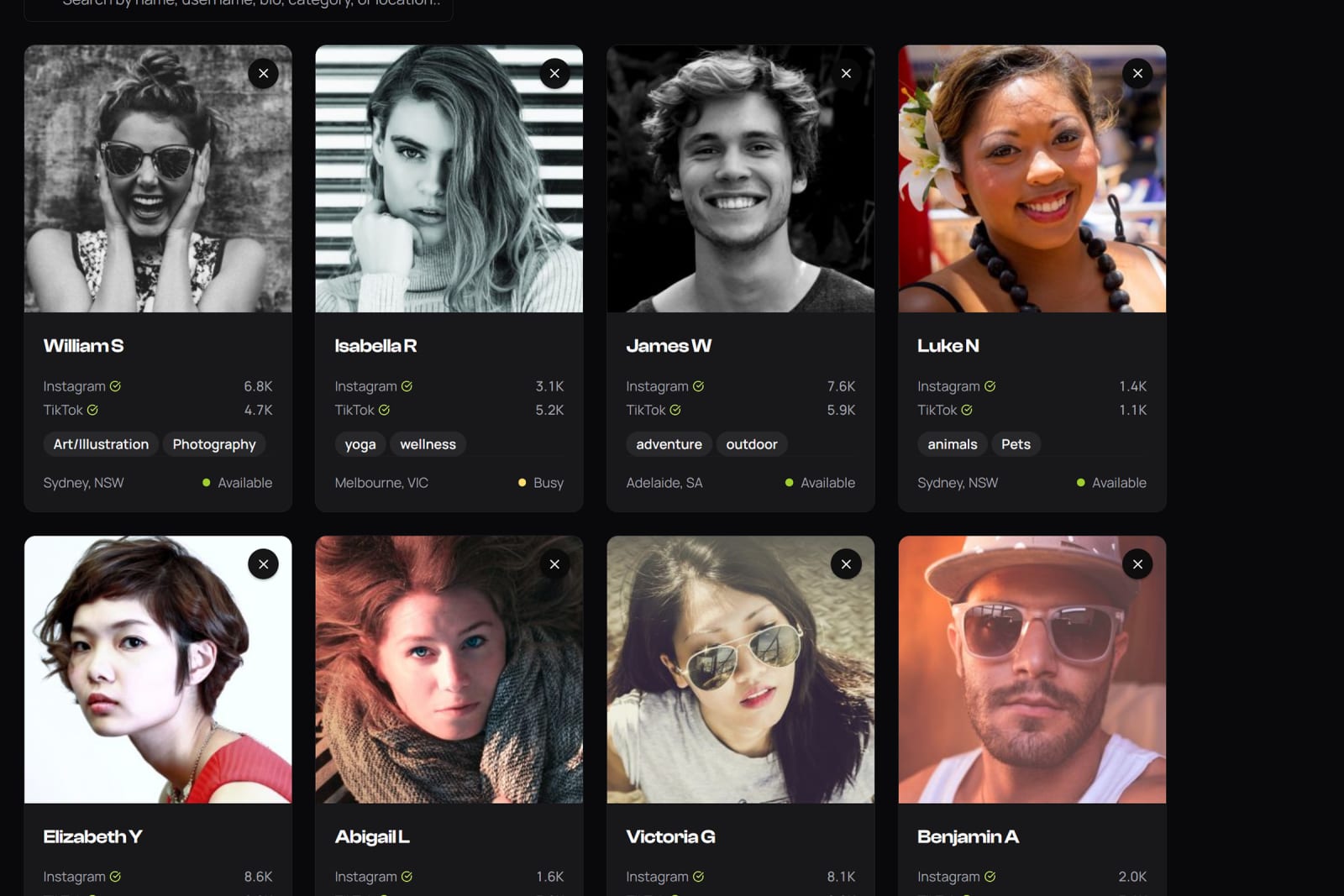
What does this look like inside Mega Donkey?
We built the platform around these two gripes specifically — not because they were trendy, but because they were the two questions we couldn’t answer cleanly when we ran our own campaigns. The thesis behind the whole product is what we call the Blanket Campaign Thesis: 100 verified micro-creators with real audiences will outperform one celebrity with a styling team, if you can prove they did. Solve trust and ROI at the same time, with the same infrastructure, and the rest of the math works itself out.
In practice that means three things. Every creator carries a Trust Score backed by audience verification — that’s the trust answer. Every campaign runs on a per-post attribution model with codes and links wired in by default — that’s the ROI answer. And the two halves talk to each other inside the same dashboard, so the next campaign starts with last campaign’s data, not last campaign’s vibes.

The two gripes aren’t going away. The brands solving them aren’t doing it with more spend; they’re doing it with better infrastructure. If you’re a brand running 10–50 micro-creators a quarter and you’re tired of running both audits — did this work, do they believe it — every campaign cycle, that’s the gap we built for.
Where this fits in our pillar
This piece is part of our pillar guide on scaling micro-influencer campaigns — covering creator volume, workflow, measurement, and brand-safety end to end. For the full playbook, start with the complete guide.
See pricing — or read why micro-influencing is still rising in 2026 and the Un-Influencer thesis for the long version of why this matters.
Ready to get started?
Launch your first campaign or join as a creator today.