Multi-Touch Attribution for Micro-Influencer Campaigns: A Practical Framework
Last-click misses up to 80% of influencer impact. Here's a practical multi-touch attribution framework built for volume micro-influencer campaigns.
By Donkey Dan, edited by Dr Brent Coker

If you’re running a 50-creator campaign and still relying on last-click attribution, you’re flying blind. Research published in 2025 puts it bluntly: last-click misses up to 80% of influencer-driven purchases. Your CMO is looking at a report that credits Google and direct traffic for sales that your creators actually started.
This isn’t a minor rounding error. It’s the single largest reason nearly 80% of marketers still say they can’t measure influencer ROI properly, citing multi-touch attribution as the biggest gap in their tech stack. Brands that shift to multi-touch models report 34% higher measured ROI on the same spend — not because the campaigns got better, but because they finally see what the campaigns were already doing.
Here’s a practical framework for building multi-touch attribution that works for volume micro-influencer campaigns — the kind we run on Mega Donkey every day. No theoretical data-science lectures. Just a workable system you can set up before your next campaign launches.
Why Does Last-Click Attribution Fail for Influencer Campaigns?
Last-click is the attribution model you get by default in almost every analytics tool. It gives 100% of the credit to whatever channel drove the final click before purchase. For search and retargeting, it’s a reasonable approximation. For influencer marketing, it’s a disaster.
Here’s why the model breaks for creator campaigns:
Influencer content sits at the top of the funnel, not the bottom. Someone sees a creator reviewing a face serum on TikTok on Tuesday. They screenshot it. On Saturday, they google the brand name, click an ad, and buy. Last-click credits the Google ad. The creator who planted the seed gets nothing. The TikTok campaign looks like it “didn’t work.”
Dark social eats the breadcrumbs. Creator content gets saved, shared in DMs, sent to group chats, and rewatched on a second device. By the time a purchase happens, there’s no clickable link in the chain — just a TikTok that convinced someone a week ago.
iOS and Chrome are making it worse. Apple’s Link Tracking Protection strips UTM parameters from shared links. Google Chrome’s third-party cookie phase-out affects an estimated 65% of web sessions. Combined with App Tracking Transparency and ad blockers, you’re losing up to 40% of referral traffic signal before it even reaches your analytics.
The result is a measurement gap so wide that 2026 research shows brands running multi-touch models discover 20–30% more influencer-attributed ROI than they had using last-click. Same campaigns, same creators — just better accounting.
Which Multi-Touch Attribution Model Fits Micro-Influencer Campaigns?
There are four models worth considering. Each distributes credit differently across the touchpoints a buyer hits before converting.
Linear attribution
Every touchpoint gets equal credit. If a buyer saw creator A, then a retargeting ad, then clicked a Google search result, each gets 33%.
Verdict: Too blunt. Treats a 3-second TikTok impression the same as a 10-minute product page visit. Useful as a sanity check, not as a primary model.
Time-decay attribution
Recent touchpoints get more credit, earlier ones get less. A creator seen a month before purchase gets a small slice; the Google ad clicked yesterday gets the largest.
Verdict: Better than last-click, but still undervalues the top-of-funnel discovery work creators do. Fine if your campaigns are short and conversion cycles are quick.
Position-based (U-shaped or W-shaped)
Credits the first touch and the last touch most heavily (40% each), with the remaining 20% split among middle touchpoints. W-shaped adds a bonus for a mid-funnel event like a newsletter signup.
Verdict: This is the model most DTC brands settle on for volume micro-influencer campaigns. It correctly credits the creator who started the journey and the channel that closed it, without ignoring the middle. Shopify brands running 50+ creator campaigns consistently use 40/20/40 position-based as their default.
Data-driven attribution
Uses machine learning (typically via GA4’s default model or Northbeam/Triple Whale’s equivalents) to assign credit based on which touchpoint sequences actually correlate with conversion in your data.
Verdict: The best model if you have enough volume to train it — typically 3,000+ conversions per month. Below that, the algorithm doesn’t have enough signal and the credit assignments become noisy. For most mid-sized brands, start with position-based and graduate to data-driven when you hit scale.
The proprietary insight here — the one almost nobody points out — is that volume micro-influencer campaigns are structurally easier to attribute than celebrity one-offs. When you have one $200K celebrity post, you have a single noisy signal buried in a quarter of other marketing activity. When you have 50 creators, each with unique promo codes, unique UTMs, and distinct content drops spaced across two weeks, you have 50 cleaner signals and a distribution you can actually analyse. The blanket campaign isn’t just a performance play — it’s an attribution play.
What Tracking Methods Actually Work at Scale?
No single tracking method captures everything. You need a stacked approach. Here’s how each one performs and where it breaks at 30–100 creator volume:
| Method | Accuracy | Main weakness | Best used for |
|---|---|---|---|
| Unique promo codes | High — direct sales proof | 20–35% drop-off between claim and purchase | Proving last-touch conversion per creator |
| UTM parameters | High for clicks, medium for conversion | Stripped by iOS 17+, lost in dark social | Traffic quality per creator |
| Affiliate links | High — automated attribution | Requires creator to use the link | Performance-based partnerships |
| Meta/TikTok pixels | Medium — privacy-limited | 20–30% signal loss from ATT and ad blockers | Retargeting and view-through |
| Post-purchase surveys | Medium — self-reported | 15–30% response rate typical | Capturing dark social and delayed conversions |
| Platform analytics | Varies by integration | Vendor lock-in, inconsistent methodology | Aggregated creator performance |
The combination that actually works for a 50-creator campaign is: unique promo code + unique UTM per creator + server-side pixel events + a post-purchase survey question. Each layer captures what the others miss.
The survey is the most underused piece. Adding “Where did you first hear about us?” to the checkout flow routinely reveals that TikTok is driving 70% of purchases when your pixel only attributed 30%. It’s the single cheapest way to close the attribution gap, and it costs nothing but a checkout field.

How Do You Build a Practical Framework for a 50-Creator Campaign?
Here’s the framework we recommend to every brand running a blanket campaign. Seven steps. Set up once, apply to every campaign.
Step 1 — Standardise your tracking taxonomy before launch
Every creator gets a consistent UTM structure. No exceptions.
utm_source=tiktok
utm_medium=influencer
utm_campaign=[campaign-slug]
utm_content=[creator-handle]
If one creator uses utm_source=TikTok and another uses utm_source=tiktok, GA4 treats them as different channels and your data splits across 50 rows. Lock the schema. Automate it. Don’t let creators build their own links.
Step 2 — Assign a unique promo code per creator
Not per campaign. Per creator. A shared code like SUMMER20 gives you a redemption total but tells you nothing about individual performance. Creator-specific codes turn every redemption into a clean attribution event.
Typical format: [CREATOR-FIRSTNAME][10-20] or a short memorable phrase tied to their handle.
Step 3 — Implement server-side event tracking
Browser pixels lose 20–30% of signal. Server-side tracking via Meta’s Conversions API and TikTok’s Events API recovers most of that loss. If you’re on Shopify, the Meta and TikTok native integrations handle this with a few clicks. For custom stacks, this is the one engineering investment worth making.
Step 4 — Add a post-purchase attribution question
“Where did you first hear about us?” with options including TikTok, Instagram, friend/word-of-mouth, Google, and other. Show it on the thank-you page or in the confirmation email. Response rates are typically 15–30%, enough to extrapolate.
Step 5 — Define your attribution window
For awareness-driven campaigns with micro-influencers, a 28-day click window and 7-day view-through window captures most conversion activity without inflating credit. For high-consideration purchases (anything over $200 AUD), extend click to 30–60 days.
Step 6 — Pick your model and commit
Use position-based 40/20/40 as your default. Run it alongside last-click in the same dashboard so stakeholders can see the delta. The gap between those two numbers is the attribution signal last-click was hiding from you.
Step 7 — Reconcile monthly with incrementality testing
Attribution tells you which channels got credit. Incrementality tells you which channels actually drove incremental sales. Run a geo-holdout or a creator pause every quarter to verify your attributed revenue reflects real lift. More on this below.

How Do You Measure Incremental Lift vs Attributed Sales?
Attribution models distribute credit for sales that happened. Incrementality testing asks the harder question: would those sales have happened anyway?
The answer changes your investment case. If your creator campaign is attributed $500K in revenue but incrementality testing shows only $300K was truly incremental (the other $200K would have converted through other channels), your real ROAS is 40% lower than your dashboard says.
Three practical methods:
Geo-holdout testing. Run the campaign in Sydney and Melbourne, hold out Brisbane as a control. Compare post-campaign revenue growth across regions. If Sydney and Melbourne grew 15% and Brisbane grew 4%, your incremental lift is 11 percentage points.
Creator pause testing. Run at full volume for two weeks, pause for two weeks, resume. Measure the baseline shift. Works best if you run continuous campaigns.
Pre/post cohort analysis. Compare customer lifetime value of influencer-acquired customers vs paid-media-acquired customers over 12 months. This is how Gymshark and Princess Polly measure the long-tail value that attribution alone misses — and it’s often where the real ROI lives.
An Australian fast-fashion example worth knowing: Princess Polly runs short micro-influencer campaigns (roughly 10-day windows), tracks attribution via unique promo codes through their Shopify and GA4 stack, and validates lift against a pre-campaign sales baseline. Their published data shows creator-driven campaigns have tripled revenue from codes versus the baseline, with a 41% sales lift in the Australian market. The attribution framework and the incrementality test together tell the full story.
What Does the Martech Stack Look Like?
You don’t need 12 tools. For a Shopify-based DTC brand running 50+ creator campaigns, the minimum viable stack is:
- Shopify for e-commerce and order attribution
- GA4 + BigQuery for multi-touch attribution and raw event data
- Meta Conversions API + TikTok Events API for server-side pixel recovery
- Klaviyo (or equivalent) for email touchpoint tracking
- A creator campaign platform for unique code and UTM generation at scale, plus structured content tracking
That’s five pieces, not fifteen. Adding specialised attribution platforms like Northbeam, Triple Whale, or Rockerbox makes sense at $5M+ ARR or when creator marketing becomes a primary acquisition channel. Below that, the standard stack does 90% of the job.
The piece most brands underinvest in is creator-side tooling. If your ops team is manually generating 50 unique codes and 50 UTM strings in a Google Sheet, you’re going to end up with three codes typed incorrectly, one campaign mistagged, and a reconciliation mess when the data comes back. Automating this at the campaign platform layer eliminates the error class entirely.
How Does Mega Donkey Simplify Multi-Touch Attribution?
Most of the friction in influencer attribution comes from decentralised tracking — briefs in Google Docs, codes generated ad hoc, UTMs half-filled. We designed the platform to fix this at the workflow level — it’s the foundation of how brands prove influencer campaign ROI without screenshots.
Tracking hygiene baked into the brief. When a brand launches a campaign on Mega Donkey, unique promo codes and UTM strings are generated automatically for every accepted creator. No manual entry. No typos. No cleanup.
One dashboard for the whole campaign. Every creator’s content, posting status, and engagement data lives in a single view. When you pull data into GA4 or BigQuery for attribution modelling, you’re pulling from a clean source — not reconciling five spreadsheets.
Structured content metadata. Because content is submitted, approved, and posted through the platform, you get clean timestamps for every post. That matters for attribution windows — you can define your 28-day click window from the exact post date, not from when someone remembered to log it.
Escrow payments tied to performance. Funds are held until content goes live and verifies. When you calculate CPA from the campaign, the cost side of the equation is clean — you only paid for what shipped.
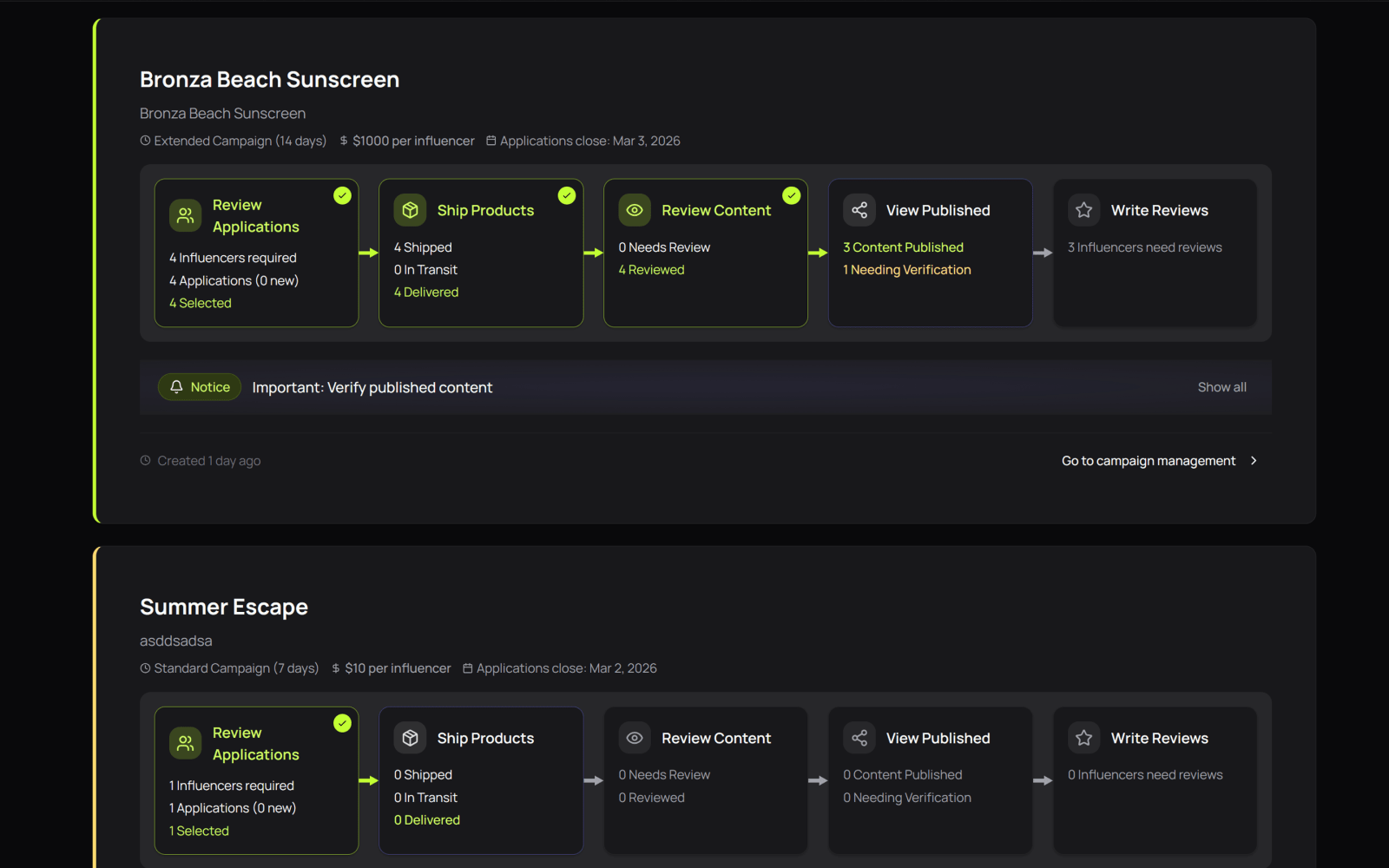
Here’s the thing worth repeating: the blanket campaign thesis isn’t just a creative argument for volume micro-influencer strategy — it’s an attribution argument. Fifty creators with fifty clean tracking stubs give you signal clarity that no celebrity campaign can match. Distributed content equals distributed, measurable conversion paths.
If your 2026 plan includes influencer marketing and you can’t currently connect awareness to conversion, attribution is the gap to close first. Model choice and tracking method second. How you actually report it third.
Where this fits in our pillar
This sits inside our broader work on measuring influencer marketing ROI — attribution, real-revenue metrics, and reporting frameworks. The pillar walks through the complete measurement playbook.
Ready to run campaigns with multi-touch attribution wired in from day one? See how Mega Donkey handles tracking hygiene at scale and launch your first blanket campaign with attribution-grade data baked in.
Ready to get started?
Launch your first campaign or join as a creator today.