How to Monetise as a Micro-Influencer in Australia (2026 Pillar Guide)
What 1k–10k creators in Australia actually earn, where the money comes from, and the AANA, ABN and ATO bits no one tells you. Built by Mega Donkey.
By Donkey Donna, edited by Dr Brent Coker

If you’ve got between 1,000 and 50,000 followers on TikTok or Instagram and you’re trying to figure out how to actually turn that audience into income — without getting ghosted, undercharging, or accidentally breaking AANA disclosure rules — this is the guide we wish someone had handed us. We’re Mega Donkey, an Australian micro-influencer marketplace, and what’s below is what we’ve learned from running the platform plus what the public benchmarks say in 2026.
We’ll cover what’s earnable, what to charge, where the deals come from, the four monetisation routes that actually work for creators under 50k, and the Australian-specific compliance bits — ABN, GST, AANA, and the ATO — that most overseas guides skip entirely.
What the 2026 creator economy looks like for Australians
The Australian creator economy crossed an estimated AU$58 billion in 2025 and is on a 19.7% compound annual growth rate to 2031, with TikTok itself forecasting a creator commercial contribution of US$100 billion by 2030 for our market alone12. The shift inside that number matters more than the number itself: enterprise marketing budgets that used to chase celebrities have moved decisively toward nano (1k–10k) and micro (10k–50k) creators. The Australian Influencer Marketing Council (AiMCO) released formal salary and rate benchmarks for the industry in 2024 — a watershed for an industry that had no public pricing standard for years3.
The mechanism is simple. Average engagement on Instagram for nano creators sits at 6.23–7.9%, versus 0.86% for macro accounts4. On TikTok, nano creators land 7.5–10.3% engagement against around 4.5% for macro. That means a brand spending the same money on twenty nano creators reaches a far more attentive audience than one celebrity post — and increasingly, brands have figured this out.
That’s the demand side. Your job is to be findable, professional and properly priced when those budgets show up.
What “monetising” actually means at 1k–50k followers
Five income streams matter at this tier. Ranked by how realistic each is at 1k–50k:
- Paid brand deals (cash) — single-post or campaign fees from a brand. Most reliable and biggest. The bulk of this guide.
- UGC-only deliverables — you create content the brand owns and posts, you don’t post it on your own feed. AU$150–$250 per video for beginners, AU$400–$1,200 per project for established creators5. Doesn’t require a big audience — it’s pure production work.
- Affiliate commissions — 5–30% on referred sales. Requires consistent traffic and a niche where audiences buy. Usually a complement to brand deals, not a replacement.
- Gifted-product partnerships — non-cash. We’re not fans, and we’ll explain why. AANA still requires disclosure even when the only “payment” is the product.
- Native platform payouts — TikTok Creator Rewards, Instagram subscriptions, branded-content tools. Real but usually small relative to brand deals at this tier.
If you take one thing from this guide: at 1k–50k followers, paid brand deals plus UGC are where the actual money is. The rest is rounding error until you’re at 100k+.
Earning benchmarks: what to charge in 2026
The single most common question we hear from Australian creators is “what should I charge?” Here’s the public 2026 floor and ceiling for organic posting in AUD, drawn from Wise’s Australian creator benchmarks and AiMCO’s industry data53:
| Tier | Instagram Reel | TikTok video | Stories (set) | UGC-only deliverable |
|---|---|---|---|---|
| Nano (1k–10k) | AU$20–$200 | AU$5–$75 | AU$10–$100 | AU$150–$250 per video |
| Micro (10k–50k) | AU$200–$1,200 | AU$75–$1,800 | AU$150–$750 | AU$400–$1,200 per project |
A few notes from running the platform:
- Reels and TikTok videos carry a 25–50% premium over a static feed post. Every credible AU benchmark agrees on this.
- Engagement rate beats follower count for pricing power. A 4,000-follower creator at 7% engagement is consistently quoting 1.5–2× what a 25,000-follower creator at 1% engagement quotes — and getting it.
- Average monthly income for actively-working AU micros sits at AU$3,000–$8,000 via a mix of retainers and 4–10 gigs5. That’s the realistic mid-band, not the tail.
Then there’s usage rights, which are a separate fee category most beginners miss:
| Usage right | What it means | Premium on top of base fee |
|---|---|---|
| Organic only | Posts to your audience, brand can’t boost | Baseline (no premium) |
| Whitelisting / dark posts | Brand runs paid ads through your handle | +50–100%6 |
| Content licensing (term) | Brand reuses content for 3–6 months | +50–150% |
| Perpetual licensing | Brand owns content forever | +100–200% or a flat buy-out |
| Exclusivity (in-niche) | You can’t work with competitors for X months | +50–300%, depending on duration |
If you only quote a per-post rate without these line items, you’re leaving 30–80% of the contract value on the table. We’ve covered the maths in detail in our spoke on valuing your social media post.
The four ways to actually get brand deals
There’s a romanticised version of this where you post great content, brands find you, deals fall in your lap. The reality, in our marketplace data: only about 5% of brands proactively recruit creators they haven’t worked with. The other 95% expect creators to come to them — through one of four routes.
Route 1: Optimise your profile so brands shortlist you
The 90 seconds a brand spends on your profile before deciding to message you is doing more pricing work than you think. Bio clarity, niche signals, contactable email, recent campaign results in highlights, a media kit link — all of it materially shifts whether you’re shortlisted or skipped. Our spoke on how to attract brand deals as a micro-influencer walks through what actually moves the needle, including what brands say they look for in our internal hiring data.
Route 2: Pitch yourself for first paid deals under AU$5,000
Most “how to pitch brands” advice assumes you already have 50k followers. If you’ve got 2,000 followers and want your first paid deal, the rules are different — you need a tighter niche pitch, a smaller initial ask, and a willingness to lead with engagement and audience demographic data instead of follower count. We unpack the exact pitch structure in how to get your first brand deal with a small following.
Route 3: Know what your work is worth before you quote
The single biggest reason creators get exploited is they don’t know their own market rate, so they accept the first number a brand offers. We built PostWorth — our free tool that values your social media posts — specifically because we got tired of watching Australian creators undercharge by 50–80% on their first ten deals. Use it before any pricing conversation.
Route 4: Apply through a marketplace instead of pitching cold
Cold pitching is high-effort and low-yield, especially under 10k followers where most agencies won’t reply. Marketplace platforms invert the model — brands publish briefs, you apply. We’ve written about the structural reasons creators are increasingly choosing platforms over DM-pitching in what creators actually want from a platform, and the comparison isn’t subtle: speed, payment safety, and access to brands you’d never otherwise hear from.

Growing the audience that brands will actually pay for
A common mistake is to optimise for follower count instead of audience quality. Brands paying nano and micro rates aren’t buying eyeballs — they’re buying attention from a defined, engaged niche. A 6,000-follower fitness creator with 8% engagement and an Australian audience is worth materially more than a 30,000-follower general-lifestyle account at 1% engagement and a global mix.
The mechanics of organic growth — the algorithmic warm-up phase, hook-driven openers, save-and-share rate as the new ranking signal, repurposing across short-form platforms — are detailed in our spoke on how to grow from 1,000 to 10,000 followers organically. The headline is that platforms in 2026 reward content that gets saved and shared, not content that gets passively liked. That single shift changes how you write your hooks and how you frame your captions.
If you remember nothing else: niche tightness plus engagement quality is what makes you payable, not raw follower count.
The TikTok Shop and creator-commerce question
TikTok Shop is the most-asked-about monetisation route in our creator community right now, and it’s also the most misunderstood for Australians. TikTok Shop has not officially launched as a domestic Australian marketplace as of writing in May 20267. There’s no localised AU TikTok Shop affiliate program you can join with an Australian bank account.
Some Australian creators are participating in the US and UK TikTok Shop affiliate programs cross-border — but doing so legitimately requires forming a foreign corporate entity (a US LLC is the typical route), opening a foreign-routing fintech account (Airwallex or WorldFirst), and configuring devices to a US or UK TikTok regional version. It’s possible. It’s not casual. We’ve gone deep on the mechanics in our spoke on TikTok Shop and the creator economy in Australia, including the tax and structural implications most YouTube tutorials skip.
Native platform payouts (TikTok Creator Rewards, Instagram Subscriptions, Series) are available to Australian creators, but at 1k–50k followers they’re typically a top-up rather than a primary income stream. Treat them as a bonus on top of brand deals, not the main game.
The Australian compliance bit nobody tells you
Half the creator-monetisation content on the internet is American and silently assumes IRS rules. Here’s what changes in Australia.
ABN — you almost certainly need one. If you’re taking paid content work with the intent to profit, the ATO treats you as running a business8. Brands can legally withhold 47% of your fee under PAYG no-ABN withholding rules unless you provide an ABN8. Most professional brand managers in Australia simply won’t engage you without one. ABN application is free at abr.gov.au and takes around 20 minutes.
GST — a hard threshold at AU$75,000. Once your gross creator turnover (cash plus market value of gifted products) hits AU$75,000 in any rolling 12-month period, GST registration is mandatory8. Domestic AU brand deals attract 10% GST. Some international affiliate income is GST-free as an export, but that depends on the specific arrangement and is worth checking with an accountant.
Income tax — gifted products are taxable. The ATO is explicit: products and services you receive in exchange for promotion are barter income, taxable at fair market value. A AU$5,000 designer bag in exchange for a Reel is AU$5,000 of declarable income, even if no money changed hands. The 2025–26 marginal rates for residents are 0% on the first AU$18,200, 16% to AU$45,000, 30% to AU$135,000, 37% to AU$190,000, and 45% above9. Plus the 2% Medicare levy on top.
AANA disclosure — non-negotiable. Section 2.7 of the AANA Code of Ethics requires any post involving payment, free product, services, or other material benefit to be clearly labelled. The labels that consistently pass review are #ad, #sponsored, or “Paid partnership with [brand]” at the start of the caption. ACCC enforcement is real and increasing — in March 2026 they fined PhotobookShop AU$39,600 for 107 Instagram posts where influencers had been instructed not to disclose gifted products, and a recent ACCC sweep found 80% of influencer posts raised concerns about disclosure10. We’ve gone deeper on the exact labelling rules in our spoke on why your business needs an ABN for influencer work in Australia.
We can’t sugar-coat this: ignoring AANA and ATO compliance is the fastest way to torch a creator career. Brands actively avoid creators with non-disclosed posts in their feed because it creates AANA exposure for them too.

Why the platform you choose changes the math
Two things we’ve learned running an Australian micro-influencer marketplace that most creator-monetisation guides won’t tell you:
Platform fees compound massively across a year. A traditional managing agency typically takes 20–30% off the top of your campaign fee. A creator marketplace with a different cost structure — for example, ours sits at 10–15% depending on plan tier — means a creator running AU$60,000 a year through it keeps roughly AU$3,000–$6,000 more in their pocket than going through a 20% agency. Across a 5-year career that’s the cost of a small car. The percentage matters.
Payment safety is what separates a job from a hobby. The single most reported pain point in our creator community is “I delivered the content and the brand ghosted me on payment.” Platforms with escrow — where the brand’s money is locked before any content is created — solve this structurally rather than relying on chasing invoices. We treat this as table-stakes; we won’t let a brand brief go live on Mega Donkey without funded escrow.

The third thing we’ve observed across thousands of campaign briefs is that revision discipline matters more than rate. Briefs that go to two revision rounds eat 1.5–3 hours of unbilled creator time, which silently drops the effective hourly rate by 30–50% on smaller deals. We cap revisions at one per submission for exactly this reason — we’d rather brands write a tighter brief upfront than burn creator time on the back end.
If you’re picking a platform, the things that actually move your annual take-home are: the platform’s fee percentage, whether escrow exists and is mandatory, whether revisions are capped, and whether disputes have an actual resolution path. We’ve laid out the comparison framework in what creators actually demand from a platform.
Frequently asked questions
How much can a micro-influencer in Australia actually earn per post in 2026?
Nano creators (1k–10k followers) typically charge AU$20–$200 per Instagram Reel and AU$5–$75 per TikTok video. Micro creators (10k–50k) sit at AU$200–$1,200 per Reel and AU$75–$1,800 per TikTok. UGC-only briefs (no posting on your own profile) sit at AU$150–$250 per video for beginners and AU$400–$1,200 per project for established creators. Source: Wise AU Influencer Marketing Guide and AiMCO benchmarks53.
Do I need an ABN to take brand deals in Australia?
If you’re being paid for content with the intent to make a profit, the ATO treats you as running a business — and brands can legally withhold 47% of your fee under PAYG no-ABN withholding rules unless you give them an ABN. Most brands won’t engage you without one. Applying for an ABN is free at abr.gov.au and takes about 20 minutes.
When do I have to register for GST?
Once your gross turnover from creator work hits AU$75,000 in any rolling 12-month period — that’s GST-inclusive total income, including the market value of any gifted products you’ve kept. Below that, GST registration is optional. Brand deals to Australian brands attract 10% GST; some international affiliate income is treated as a GST-free export.
Are PR boxes and gifted products taxable income?
Yes. The ATO treats gifted products and services received in exchange for promotion as barter income, taxed at the fair market value of the item. A AU$5,000 designer handbag in exchange for a Reel is AU$5,000 of declarable income. This is one of the most common compliance failures we see in creators.
What does AANA require me to disclose on a paid post?
Section 2.7 of the AANA Code of Ethics requires a clear, prominent label on any post where you’ve received payment, free product, services, or another material benefit. The labels that consistently pass are #ad, #sponsored, or “Paid partnership with [brand]” placed at the start of the caption — not buried under a “Read more” fold.
Has TikTok Shop launched in Australia yet?
As of writing in May 2026, TikTok Shop has not officially launched as a domestic Australian marketplace. Cross-border participation in the US and UK TikTok Shop affiliate programs is technically possible for Australian creators, but doing it legitimately requires a foreign corporate entity (typically a US LLC), a foreign-routing fintech account, and dedicated geographic configuration. Most Australian creators we work with treat this as out-of-scope until domestic launch.
Is it worth going through a platform like Mega Donkey instead of pitching brands directly?
It depends on your bottleneck. If your bottleneck is brands ghosting your DMs or pay arriving 90+ days late, a marketplace with escrow and a brand-side dashboard solves that. If you have warm brand relationships already, direct pitching keeps more margin. Most creators we see use both: marketplace work for steady cashflow, direct deals for retainer relationships.
What’s the minimum follower count brands actually pay for?
1,000 followers is the working floor across most paid platforms — including Mega Donkey, where verification kicks in at 1k. Below that, brands tend to use gifting or product seeding instead of cash. The bigger gate is engagement quality: a 4,000-follower creator sustaining 6%+ engagement out-earns a 25,000-follower creator at 1% on every credible platform we’ve measured.
Your next move
If you’re a creator between 1,000 and 50,000 followers in Australia, the highest-impact thing you can do this week is get your ABN sorted, pick one of the four brand-deal routes above, and stop replying to “we’ll send you product” emails. The cash brand-deal market is big, growing, and increasingly accessible to creators at your tier — but only if you turn up to it as a professional.
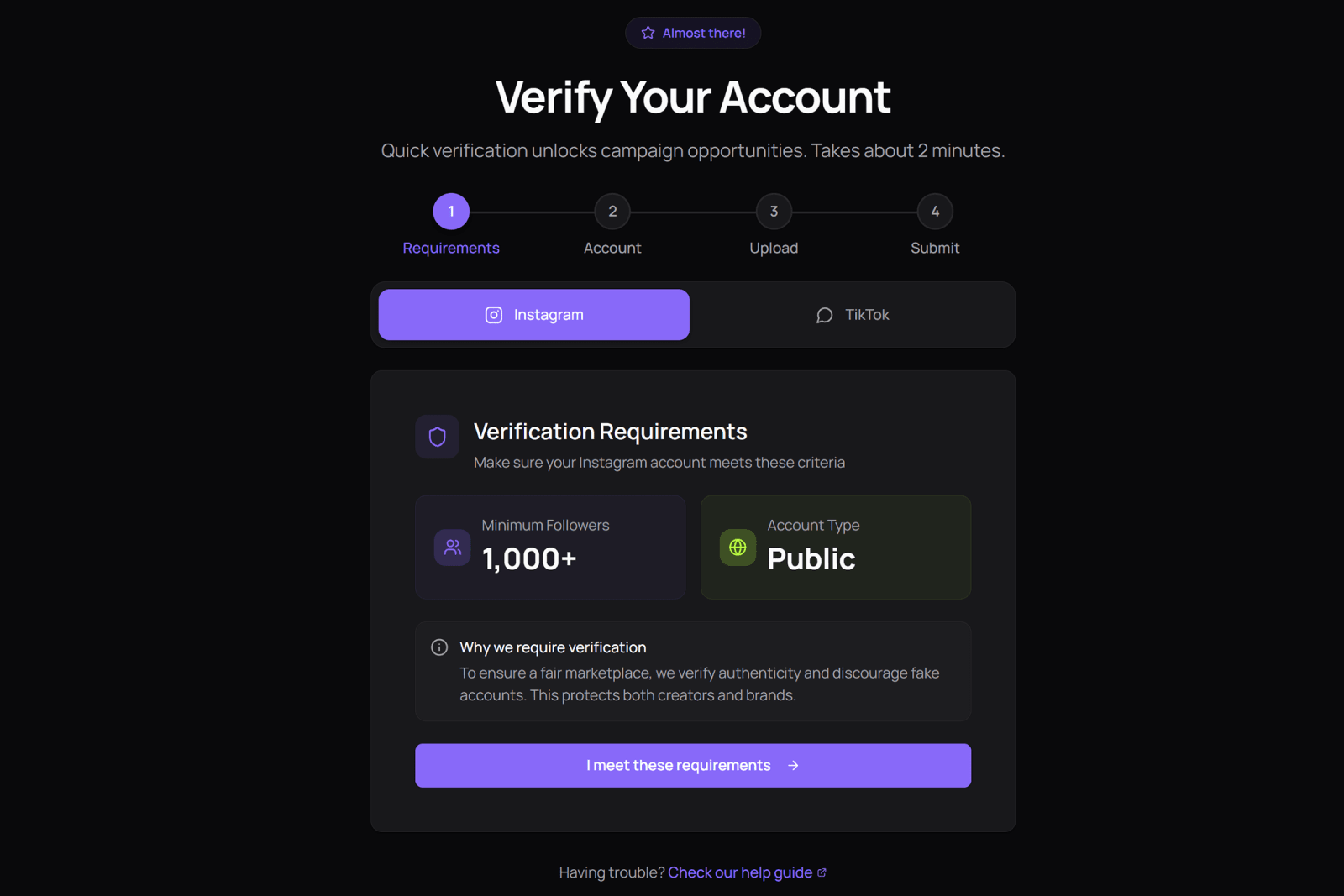
We built Mega Donkey specifically for this. If you want a paid-only marketplace where the money is held in escrow before you start working, where briefs are written by AI so they’re actually clear, and where 1,000-follower creators can apply alongside 50,000-follower creators on equal footing — join Mega Donkey as a creator. Verification takes 2–5 minutes and unlocks access to live, paid campaigns.
— Donkey Donna, edited by Dr Brent Coker
References
Footnotes
-
Mediaweek — “TikTok forecasts $100bn creator economy surge in Australia by 2030” — https://www.mediaweek.com.au/tiktok-creator-economy-australia-100bn-2030/ ↩
-
Australia creator-economy size estimate (USD 38.5B 2025, ~AU$58B at parity, 19.7% CAGR to 2031) — Perplexity Sonar Pro Search aggregation, May 2026. ↩
-
AdNews — “AiMCO’s salary benchmarking for influencer industry” — https://www.adnews.com.au/news/aimco-s-salary-benchmarking-for-influencer-industry ↩ ↩2 ↩3
-
BBB National Programs — “2025 Influencer Trust Index” — https://bbbprograms.org/getmedia/534acbf7-efdb-45aa-a40e-68394ff56f47/2025_InfluencerTrustIndex.pdf and Statusphere — “Micro-Influencers: The 2025 Guide for Brands” — https://brands.joinstatus.com/what-are-micro-influencers ↩
-
Wise — “Guide on Influencer Marketing in Australia 2025” — https://wise.com/au/blog/influencer-marketing ↩ ↩2 ↩3 ↩4
-
Shopify — “Micro Influencers in 2026: Playbook for Cost, Compliance, and Conversion” — https://www.shopify.com/au/enterprise/blog/micro-influencers-instagram ↩
-
ContentGrip — “Why TikTok Shop hasn’t launched in Australia yet” — https://www.contentgrip.com/tiktok-shop-australia-delay/ ↩
-
Dolman Bateman — “Do I Need to Pay Tax If I’m an Influencer?” — https://www.dolmanbateman.com.au/blog/do-i-need-to-pay-tax-if-im-an-influencer ↩ ↩2 ↩3
-
National Accounts — “How Much Tax Do TikTok Creators Pay in Australia? (2026 Rates)” — https://www.nationalaccounts.com.au/blog/tiktok-and-taxes-what-are-the-rules-in-australia/ ↩
-
ACCC — PhotobookShop influencer disclosure penalty (March 2026) — public ACCC enforcement record; AANA Code of Ethics Section 2.7 — https://aana.com.au/self-regulation/codes-guidelines/code-of-ethics/ ↩
Ready to get started?
Launch your first campaign or join as a creator today.