What Every Creator Should Demand from an Influencer Platform in 2026
The nine non-negotiables every micro-creator should demand from any influencer platform — escrow, fixed rates, one revision, no spec work, AANA-compliant disclosure, and more.
By Donkey Donna, edited by Dr Brent Coker

If you’re a creator with 1,000 to 10,000 followers, the influencer industry has spent years quietly assuming you don’t deserve the same protections as the big accounts. Late payments. Endless revisions. “Exposure” deals. Vague briefs that mutate halfway through. A 5,000-follower minimum that locks you out before you’ve even started.
None of that is normal, and none of it should be acceptable. We’ve put together the nine non-negotiables you should be demanding from any influencer platform in 2026. If your current platform fails on more than two of these, you’re being underserved.
1. Money in escrow before you create a single thing
The most basic dignity in this industry is also the rarest: getting paid for the work you do. The Australian Competition and Consumer Commission’s influencer sweep media release reviewed 118 creators across Instagram, TikTok and YouTube and found 81% were making posts that raised concerns under the Australian Consumer Law. That’s the disclosure half of the trust problem. The other half is whether the brand actually pays you when the content is live.
What good looks like: the platform charges the brand the moment they accept your application. The money sits in escrow — actual locked funds, in a real bank — before you film a single second. After you post, an auto-release timer starts (Mega Donkey runs a 10-day countdown). If the brand forgets to click “release,” it releases anyway. You should never wait on a brand to remember they owe you.
If the platform’s “payment protection” is just a promise the brand will pay later, that’s not protection. That’s marketing.

2. Fixed rates, posted upfront — no negotiation theatre
Negotiating in DMs is a tax on creators who don’t have agents. You undersell yourself because you’re scared of getting ghosted; the brand pretends “this is all the budget we have”; the rate ends up at whatever number kills the awkwardness fastest.
Demand a platform that publishes the rate before you apply. You see the brief, you see the dollar figure (in AUD, not USD with a footnote), you see the deliverables. If the rate’s worth your time, you apply. If it isn’t, you scroll on. No haggling, no media-kit war games, no “what’s your rate?” anxiety.
Fixed pricing is also why brand–creator matches happen faster on platforms that use it. There’s nothing left to argue about.
3. A one-revision rule, enforced by the platform — not the brand
“Just one more tweak” has cost creators billions of unpaid hours. The pattern is universal: you submit content, the brand asks for changes, you revise, they ask for more changes, the original brief drifts, and suddenly you’re doing $2,000 worth of agency work for a $200 fee.
A real one-revision rule isn’t a polite suggestion. It’s a structural limit baked into the platform — one revision per submission, with structured feedback categories so the brand has to be specific about what they want fixed (caption, brand mention, hashtags, video quality), not “make it pop.” A 48-hour deadline for the revision. After that, payment releases.
Without enforcement, “one revision” is whatever the brand decides it is. A platform-enforced one-revision rule is the single piece of structure that protects creators more than any contract clause does.
4. No spec work — apply, get hired, then create
If a platform asks you to film content before you know whether you’ve been hired, walk away. That’s spec work, and it’s how creators end up shooting concept reels brands either ghost on or quietly repurpose.
The right model: you read the brief, you submit a short application (a sentence or two on your angle, links to recent work), the brand picks from the applicant pool, you get an acceptance notification, and only then do you start filming. Your time is paid time, not free pitching.
This sounds basic. A surprising number of platforms still flip the order.
5. Status updates at every step — no more black-hole applications
The “I applied for 50 brand deals and never heard back” experience is the single fastest reason creators quit the industry. Silence isn’t rejection — rejection is information. Silence is just disrespect.
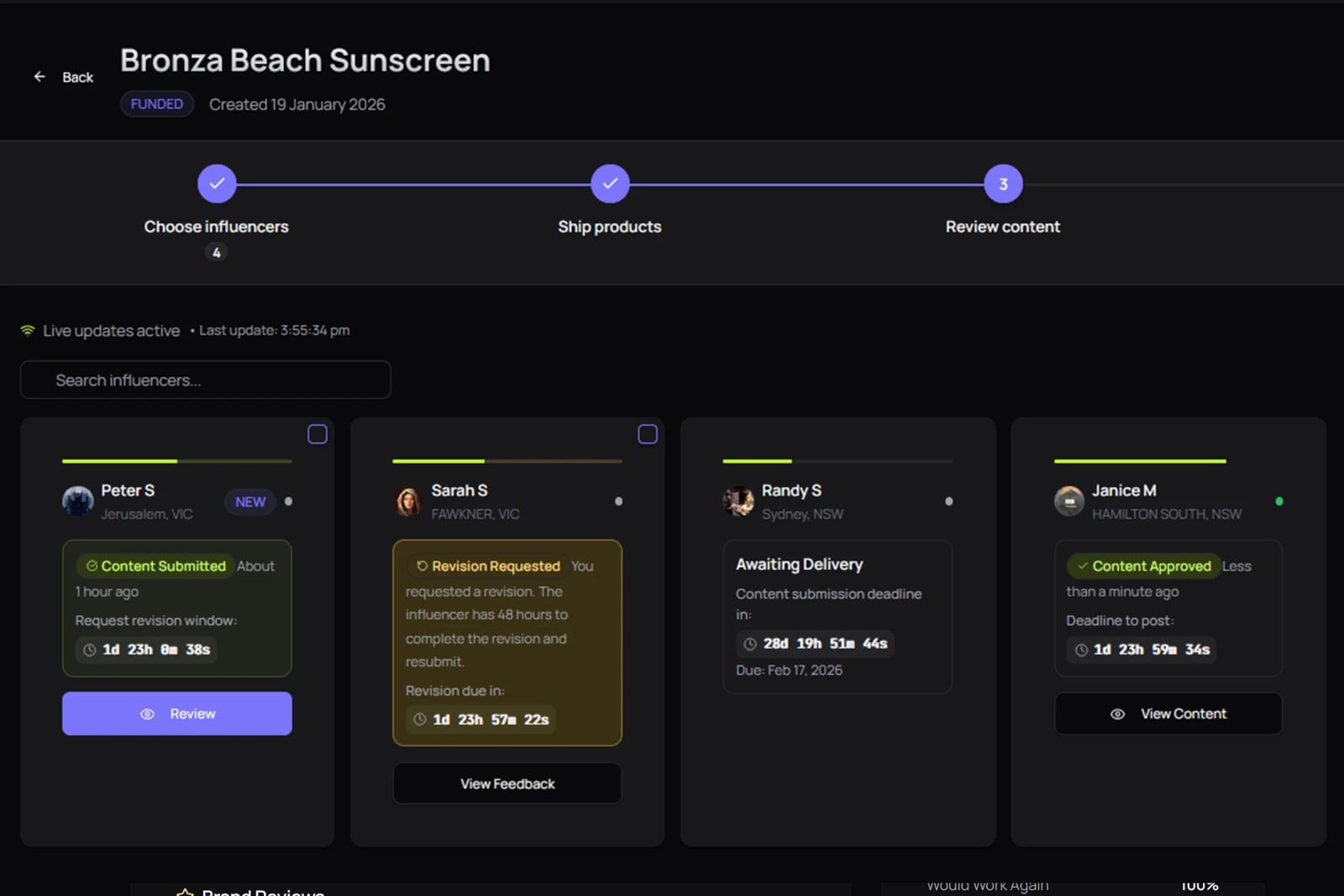
Your platform should give you a clear status at every stage: Applied → Accepted → Content Submitted → Approved → Posted → Paid. Notifications when state changes. Deadlines visible to both sides. If a brand is sitting on your application for three weeks, the platform tells you, and ideally times them out.
This isn’t a nice-to-have. It’s the difference between a job pipeline and a wishing well.
6. A real follower-count floor that includes creators under 5k
Most “influencer marketplaces” set their minimum at 5,000 or even 10,000 followers. That’s an industry pretending the data agrees with it. It doesn’t.
Nano- and micro-influencer share of Instagram base: ~76% (creators under 10k followers). Source: Influencer Marketing Hub Benchmark Report 2025.
The same report shows engagement rates declining as follower counts climb. Brands that understand the maths are actively hiring sub-5k creators because the conversion-per-dollar is better. A platform that locks them out is choosing legacy gatekeeping over current research.
The right floor is 1,000 verified followers with a real engagement rate — that’s the level at which you have a genuine community without yet being eaten by an algorithm. If your platform won’t accept your application at 1,500 followers, that platform is not built for you.
7. AANA-compliant disclosure built in — not bolted on
Australian creators sit under the AANA Code of Ethics — every paid, gifted, or affiliate piece of content needs clear, visible disclosure (like #ad in a position the audience actually sees, not buried mid-caption). Get this wrong and the ACCC has shown — 81% of the 118 creators in their sweep raised concerns — that they will treat it as a consumer-protection issue, not a vibes issue.
Your platform should make this trivially correct: campaign templates that auto-include the disclosure copy, a content checklist that flags posts missing #ad before you submit, a paper trail showing the disclosure was specified in the brief. You shouldn’t be the last line of defence on Australian advertising law. Not at 2,000 followers.
8. A portable reputation that travels with you
Most platforms treat reputation as a hostage. Do good work, build five-star reviews, then leave the platform — and your history vanishes. Brands you reach out to next never see the receipts.
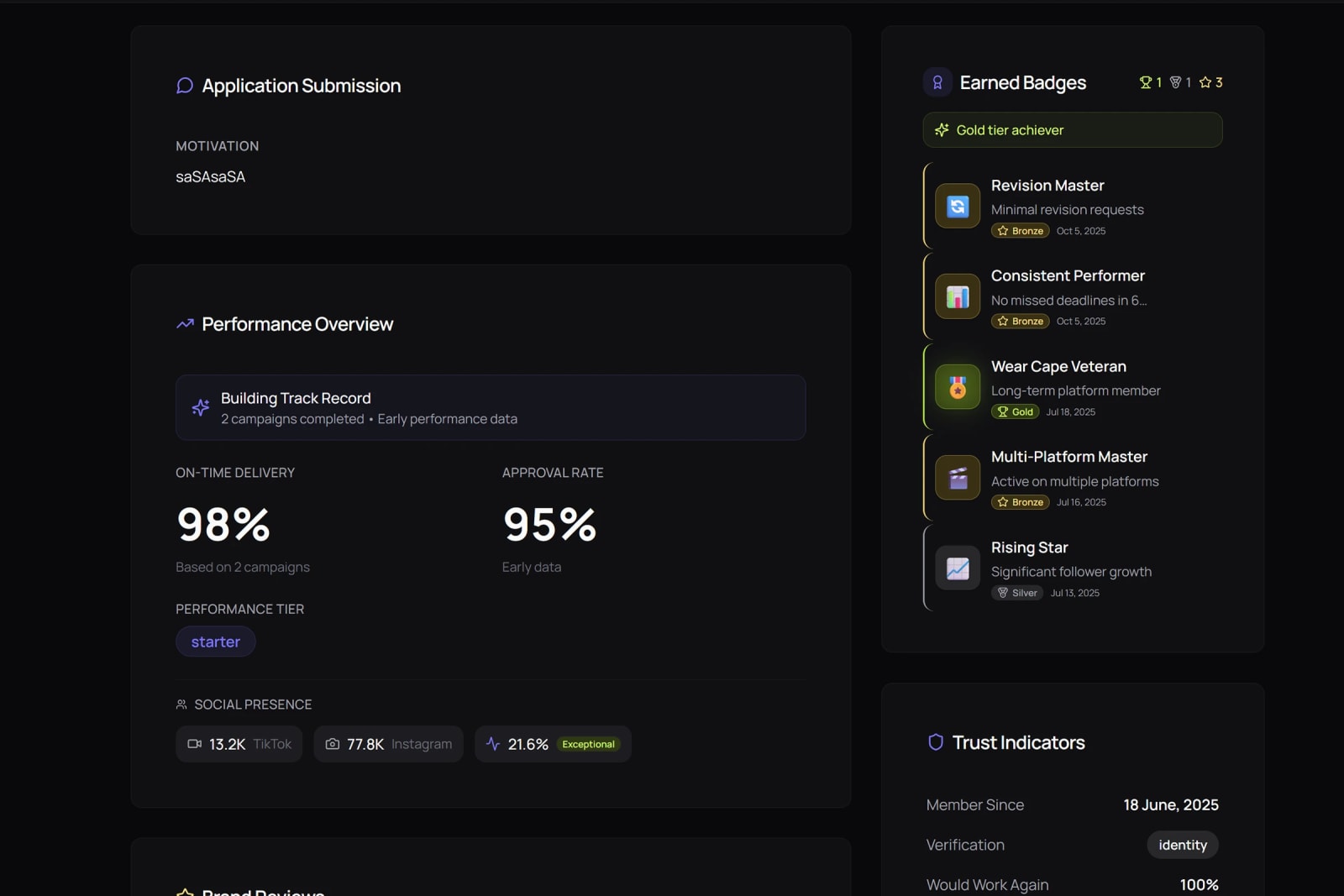
What good looks like: a transparent score (Mega Donkey weights ours 25% reliability, 40% quality, 10% communication, 15% satisfaction, 10% experience), badges that expire after 180 days so they reflect recent work, and reviews you can show off-platform. Your reputation is yours. The platform is the witness, not the owner.
This matters even more if you’re early. A 7,000-follower creator with a verified 92 reliability score outperforms a 50,000-follower creator with no track record on most brand-side acquisition metrics. Your professionalism is a moat — but only if it’s visible. Our guide on how to attract brand deals as a micro-influencer walks through how to make that reputation legible to brand managers in the first place.
9. AUD payments, Australian compliance, Australian support
A US-built platform with a Sydney login screen is not an Australian platform. AUD payments without conversion fees. Support that answers in your timezone. ABN handling that doesn’t assume you’re a US corporation. ATO-compatible payment receipts. AANA-aware disclosure flows.
Australian nano-influencer rates (1k–10k followers): AU$16–AU$156 per Instagram post. Source: StarNow Australia influencer rate guide, 2025.
That’s a real spread, but it’s all in AUD — and a platform that quotes you USD or ”$” without the currency code is one that hasn’t actually thought about you. If something goes wrong, you want a dispute resolution flow that runs in business hours you live in, not a queue handed off to overnight contractors on the other side of the world.
How to audit your current platform
Run through the nine demands above. Score honestly. If your platform clears seven or more, you’re with a serious one — keep building reputation there. If it clears four to six, you’re tolerating real friction; start applying elsewhere as a hedge. If it clears three or fewer, you’re working for a platform, not the other way around.
Mega Donkey was built around exactly this checklist. Escrow, fixed pricing, a structurally enforced one-revision rule, no spec work, status tracking, a 1,000-follower floor, AANA-aware briefs, portable Trust Scores, and AUD-native payments. We’re the Australian-built platform for the 1k–10k creator segment, made by a team that uses it.
Frequently asked questions
What’s the smallest follower count where a serious influencer platform will take me seriously?
A serious platform should accept you at 1,000 verified followers with a real engagement rate (above 2% on Instagram, above 4% on TikTok). If a platform’s stated minimum is 5,000 or 10,000, it’s built for the agency model, not the micro-creator model. Look elsewhere — and read our guide to monetising as a micro-influencer for the broader picture on where small accounts can actually earn.
Is gifting (free product) ever a fair payment for content?
Almost never. The maths is simple: your time, equipment, editing software, props, and audience access have a real dollar cost. A AU$50 product doesn’t cover that even at one post per month. Gifting can make sense as a bonus on top of paid work, or as a one-off if a brand you genuinely love is genuinely tiny — but a platform whose default model is gifting-only has decided creators are the cheapest line in their budget.
What is a fair revision policy?
One revision per submission, requested within 48 hours of you submitting, with the brand required to specify what they want changed using structured categories — not “make it better.” If they don’t request a revision in time, the content is auto-approved. If you don’t deliver the revision in time, the brand can reject. Both sides have skin in the game.
Do I need an ABN to use Australian influencer platforms?
If you’re earning regular income from creator work, yes — but the threshold is lower than most creators realise. The ATO uses a hobby-versus-business test, not a hard income line. The short version: if you’re applying for paid campaigns repeatedly, get the ABN early. It’s free, and most Australian platforms need it on file before they can pay you. (General information only — for your specific situation, check ato.gov.au or talk to an accountant.)
How do I know a platform actually enforces escrow rather than just promising it?
Three checks. One: the brand’s payment status is visible on your dashboard the moment they accept you (“Funds held”). Two: there’s a documented auto-release timer (Mega Donkey’s is 10 days after post verification). Three: there’s a dispute resolution process that freezes the funds if either side raises an issue. If you can’t see all three in the platform’s help docs, the escrow is decorative.
What disclosure language should I use to stay AANA-compliant?
The safest minimum: #ad placed at the start of the caption (or as the first hashtag, before the cut-off), in the same language as the rest of the post, on every paid or gifted piece of content. The AANA Code of Ethics calls for the disclosure to be “clear, prominent and not hidden.” Buried-in-hashtag-cluster placement won’t pass an ACCC sweep.
The bar is rising
For years the industry has been able to underpay, ghost, and over-revise small creators because there was nowhere for them to go that did better. That’s changing. The platforms that will win the next five years are the ones that treat 2,000-follower creators with the same procedural respect as 200,000-follower ones.
You don’t have to wait for the industry to grow up. Use the demand list above. If your current platform fails it, your next move is to find one that doesn’t.
Apply to Mega Donkey — it’s free to apply, our minimum is 1,000 followers, and the standards above aren’t aspirational. They’re how we run.
Ready to get started?
Launch your first campaign or join as a creator today.