Measuring Influencer Marketing ROI: Beyond Vanity Metrics
An Australian-grounded pillar on measuring influencer marketing ROI in 2026 — what to track, what to ignore, and why portfolio-level maths beats per-creator maths.
By Donkey Dan, edited by Dr Brent Coker

The “average $5.78 ROI per $1 spent” stat at the top of every influencer marketing article comes from a 2015 marketer-self-report survey of about 130 US respondents. It is a zombie. We’ve spent the last 18 months running portfolios of 1k–10k follower campaigns through Mega Donkey, and the number that actually moves for an Australian brand spending under A$50,000 a quarter looks nothing like that headline. Measuring influencer marketing ROI in 2026 is a tractable problem if you stop measuring the wrong things, accept that the click trail is broken, and run the maths at the portfolio level rather than the per-creator level.
This is a pillar guide. We’ll cover the metrics that survive a CFO’s questions, the attribution stack that survives Apple and Google’s privacy changes, the Australian regulatory context that changes what counts as a clean dollar, and the four spoke posts that go deeper on each piece.
Why are most influencer ROI numbers you read wrong?
There are three reasons the influencer ROI number sitting in your last campaign deck is probably wrong.
The headline stats are zombies. “$5.78 ROI per $1” traces to a 2015 Tomoson marketer-self-report survey of approximately 130 respondents.1 “92% of consumers trust recommendations” is a 2012 Nielsen attitudinal figure recycled annually. “37% of accounts are fake” comes from one vendor’s white paper with non-auditable methodology. Every one of these gets quoted by the top-ranking pages on this exact search term, including by us in earlier posts. We’re correcting course publicly because nothing kills credibility with a CFO faster than a stat they can’t trace to a primary source.
Last-click attribution invents the wrong winner. A buyer sees a creator on TikTok on Tuesday, screenshots the product, googles your brand on Saturday, clicks a branded search ad, and converts. Last-click credits Google. The creator gets nothing. Independent analysis published through Layerfive in 2026 estimates last-click models miss up to 80% of actual influencer-driven purchases.2 When a CMO cuts creator budget because the dashboard shows weak last-click ROAS, branded search shrinks two months later because the demand-creation upstream of it has been starved.
Vanity metrics confuse activity with outcome. A like takes a second. It requires no intent, no consideration, and no relationship to revenue. We’ve covered this at length in beyond vanity metrics: what brand managers actually need to report from an influencer campaign, but the headline is unchanged: if your wrap deck leads with impressions and follower counts, you’re inviting the next budget cut.
The defensible alternative is to measure the four numbers a finance team actually cares about, run them at the portfolio level, and triangulate causation through small incrementality tests. That’s the rest of this guide.
What four numbers should a brand manager actually report?
A brand manager who walks into a finance review with five metrics rather than five hundred wins the conversation. The five below are the ones we recommend for any micro-influencer programme spending A$5,000–A$50,000 a quarter.
True Customer Acquisition Cost (CAC): Total fully-loaded campaign cost divided by net-new customers acquired. Fully-loaded means creator fees, platform fees, the cost of goods for product samples, shipping, and the time of whoever is running the programme. Brands that exclude product samples and shipping understate CAC by 15–40% on gifted programmes. If your CAC is A$48 and your gross profit per first order is A$32, the programme is bleeding cash on first purchase — you’d better have a strong LTV story.
Contribution profit: (Tracked revenue × gross margin %) − (total creator-related cost). A positive contribution profit proves the creator is paying for their own marketing expense out of the gross margin they generated. A negative number on a campaign you ran for “brand awareness” means you spent gross profit you can’t get back; brand awareness should still be paid for from a separate awareness budget, not subsidised by deliberate revenue losses.
Breakeven ROAS: 1 ÷ gross margin %. A 60% gross margin business needs 1.67× ROAS just to break even on a campaign at the contribution line. A 30% gross margin business needs 3.33×. Any creator returning below this threshold is being subsidised by other creators in the portfolio or by other channels — and the dashboard ROAS number that looks “okay” at 2× is actually a loss.
LTV-to-CAC ratio: Customer lifetime value divided by True CAC. Investors and boards generally look for 3:1 or higher, with 2:1 acceptable for challenger brands chasing market share. The good news for micro-influencer programmes: customers acquired through trusted creators show measurably higher repeat-purchase rates than paid-search-acquired customers, which lifts the LTV numerator over time and improves the ratio without you needing to lower CAC.
Payback period: True CAC ÷ monthly gross profit per customer. Tells you in months how long until the cash you spent on a creator comes back. Subscription brands and SaaS look for 12 months or less; one-shot purchase categories need to recover in the first transaction.
These five sit on a CFO’s monthly report comfortably. The 47 metrics in your platform’s analytics view do not.

What attribution stack actually survives 2026 privacy?
There is no single attribution method left that survives 2026 on its own. The post-cookie, post-iOS-17 reality is that you need a stack of overlapping signals, each of which captures what the others miss.
Per-creator promo codes are the most deterministic layer. A code is captured at checkout, attached to a specific creator, and survives every browser, app and device. The trade-off is a 20%–35% drop-off between code claim and code redemption — buyers screenshot codes, paste them later, and forget half the time. Treat redemption as a floor on conversion, not a ceiling.
Unique UTM parameters per creator still work in the click path, but they’re degrading. iOS 17+ Link Tracking Prevention strips tracking parameters like gclid and fbclid from links shared in Mail, Messages and Safari Private Browsing.3 What survives are first-party UTMs on direct outbound clicks from creator bio links and TikTok link stickers — useful, but partial.
Server-side pixel events via Meta’s Conversions API, TikTok’s Events API and Google’s enhanced conversions recover 20%–40% of the conversion signal lost to ad blockers and Safari ITP. Your developer or fractional analytics partner needs to wire these — it’s not a click-and-go setup, but it’s the difference between seeing 60% of your conversions and seeing 95%.
Post-purchase surveys (“How did you first hear about us?”) capture dark social — the screenshots, DMs, group chats and rewatches that have no clickable trail. Response rates are 15%–30%. The survey is the only layer that catches a buyer who saw a TikTok, told a friend, who told a friend, who then bought.
The combination that works for a 30–100 creator AU programme: per-creator promo code + unique UTM + server-side pixel + survey. We go deep on this in multi-touch attribution for micro-influencer campaigns: a practical framework, with model selection (linear vs time-decay vs position-based vs data-driven), credit-waterfall logic to prevent double-counting, and the actual Australian DTC stack we recommend.
Why does portfolio-level maths beat per-creator maths?
Here’s a proprietary insight from running the marketplace. Volume micro-influencer campaigns are structurally easier to attribute than celebrity one-offs, and this changes the entire shape of the ROI calculation.
When you run a single A$200,000 macro post, you have one noisy signal buried in a quarter of other marketing activity. The lift could be the post, could be a press cycle, could be seasonality, could be the new ad creative your performance team launched the same week. You’ll never know with confidence.
When you run 50 nano creators in the same window, each with a unique promo code, a unique UTM, and content drops staggered across two weeks, you have 50 cleaner signals and a distribution you can analyse statistically. The portfolio-level maths shifts from “did this creator return X” to “what’s the median, the variance, and the long tail of the portfolio.” That’s a question a finance team can answer.
The implications are concrete:
- You can run incrementality at the portfolio level rather than the creator level. Hold out 10 creators across a matched cohort, activate the other 40, and compare cohort-level conversion. You don’t need a randomised audience trial to do this.
- You can identify the top quartile of creators by contribution profit and concentrate the next campaign’s budget there. The Beichert et al. Journal of Marketing 2024 field study — 1,698 influencers, 2,808 codes and €17m revenue — confirms nano creators (1k followers) generate roughly 5× more revenue per follower than macro creators and around 20× ROI on a typical paid post.4 The maths only works if you can identify which nanos are in the top quartile, which requires running a portfolio first.
- You stop optimising for a single noisy outcome. If one creator goes viral and one underperforms, the portfolio absorbs both. The variance is the asset.
Mega Donkey’s fixed-price model removes the second-largest data-pollution source in this whole exercise: per-creator price negotiation chaos. When the same deliverable is quoted A$500 to A$5,000 across different agents and channels — and trade reporting confirms 4× to 10× variance is normal in the AU market — your CAC denominator is fiction. Fixed prices make the maths comparable across creators. Escrow release tied to verified delivery removes the third-largest pollution source: late-payment ghost outcomes that never close in your books.

What does incrementality testing look like for an Australian SMB brand?
Incrementality is the only method that proves causation rather than correlation. Without it, you’re at best demonstrating “creators were touched by buyers who also converted” — which a sceptical CFO will not accept as proof of incremental revenue.
The good news: you don’t need a data-science team or a six-figure platform to run a defensible incrementality test on an AU micro-influencer programme. The bad news: most brands skip the design step and end up with a result that doesn’t hold up.
Three approaches that work at SMB scale.
Geographic holdout. Pick three to four matched Australian metros — Sydney and Melbourne paired against Brisbane and Adelaide, for example. Activate creators with regional targeting in two metros and withhold in the other two. Run for at least four weeks. Compare conversion-rate lift in test vs control regions. This works because metro-level audiences are large enough to absorb noise, and Australia’s geography happens to give you natural cohorts.
Audience-level conversion lift. Use Meta’s or TikTok’s brand-lift study tools to randomly assign exposed and unexposed cohorts within the same metro. Best for paid amplification of organic creator content (whitelisting). Requires a meaningful paid-amplification budget — typically A$10,000+ — to reach statistical significance.
Time-based holdout. Run the programme for four weeks, pause for four weeks, run again for four weeks. Compare conversion velocity in active vs paused windows, controlling for seasonality and other concurrent marketing. Cheaper than geo-testing but harder to defend if anything else changed in the paused window.
Whichever you pick, three rules:
- Sample size first. Use a power calculation to confirm you can detect a 5%–15% lift with 80% statistical power. If you can’t, the test will be inconclusive regardless of how clean the design is.
- Pre-register the hypothesis. Write down what you expect to see and what threshold counts as a result, before you start. Otherwise you’ll find a way to read the data favourably afterwards.
- Action the result. If a cohort shows strong attribution but weak incrementality (i.e., they captured demand that would have converted anyway), shrink the budget. If a cohort shows weak attribution but strong incrementality, expand it.
This is the bar a CFO will accept. Anything less is observational data dressed up as causal proof.
What does the Australian regulatory context add to the ROI maths?
This is where most US-centric ROI articles fall over, and where Australian brand managers need to pay attention.
ACCC enforcement is no longer theoretical. In March 2026, the ACCC issued infringement notices totalling A$39,600 to Photobookshop (Tomsem Consolidated Pty Ltd) for breaches spanning August 2024 to September 2025 — 107 instances of instructing influencers not to disclose gifted products, plus a separate notice for editing negative comments out of a review video.5 The penalty itself is small relative to a marketing budget; the precedent is what matters. Hypetap’s managing director described it publicly as the moment that “kills the wait-and-see approach.” Build the cost of compliance — disclosure auditing, contract clauses, penalty risk — into the CAC denominator.
AANA Code of Ethics Section 2.7 is the actual rule. Advertising must be clearly distinguishable as such; in practice, that means #ad, #sponsored, or “paid partnership” tags must appear in the first frame of video, in the first line of a caption, and not be buried in a hashtag pile.6 The disclosure does not hurt engagement; the academic evidence on the Australian disclosure × micro-influencer interaction (Mulcahy et al., Journal of Marketing Management, 2020) actually shows highest purchase intent occurs with disclosed micro-influencer content. Compliance and performance are not in tension; pretending you don’t have to disclose is the only thing that’s in tension with both.
ATO Sharing Economy Reporting Regime. From 1 July 2024, electronic distribution platforms (TikTok, YouTube, OnlyFans, Patreon and others) report Australian creators’ earnings to the ATO for data-matching against tax returns.7 This affects creators directly, but it changes brand behaviour too — creators are increasingly required to invoice with an ABN, and the brand’s payment records will eventually be reconciled against creator tax positions. Pay through escrow with auditable records, and price into the True CAC the time spent on payee admin.
TikTok Shop has not launched in Australia as of mid-2026. Brands are using cross-border selling to other markets, and AU attribution is not yet complicated by TikTok Shop’s 7-day click / 1-day view attribution windows. When the platform launches locally — and it will — re-do the attribution stack to handle the new identity-resolution surface.
Currency: report in AUD. US-sourced ROI benchmarks ($5–$10 ROAS, $0.20 CPE) need converting before they’re compared to AU campaign maths. The biggest single error we see in AU brand marketing decks is comparing a US-benchmark ROAS to an AU-actual ROAS without flagging the currency. Don’t do this.
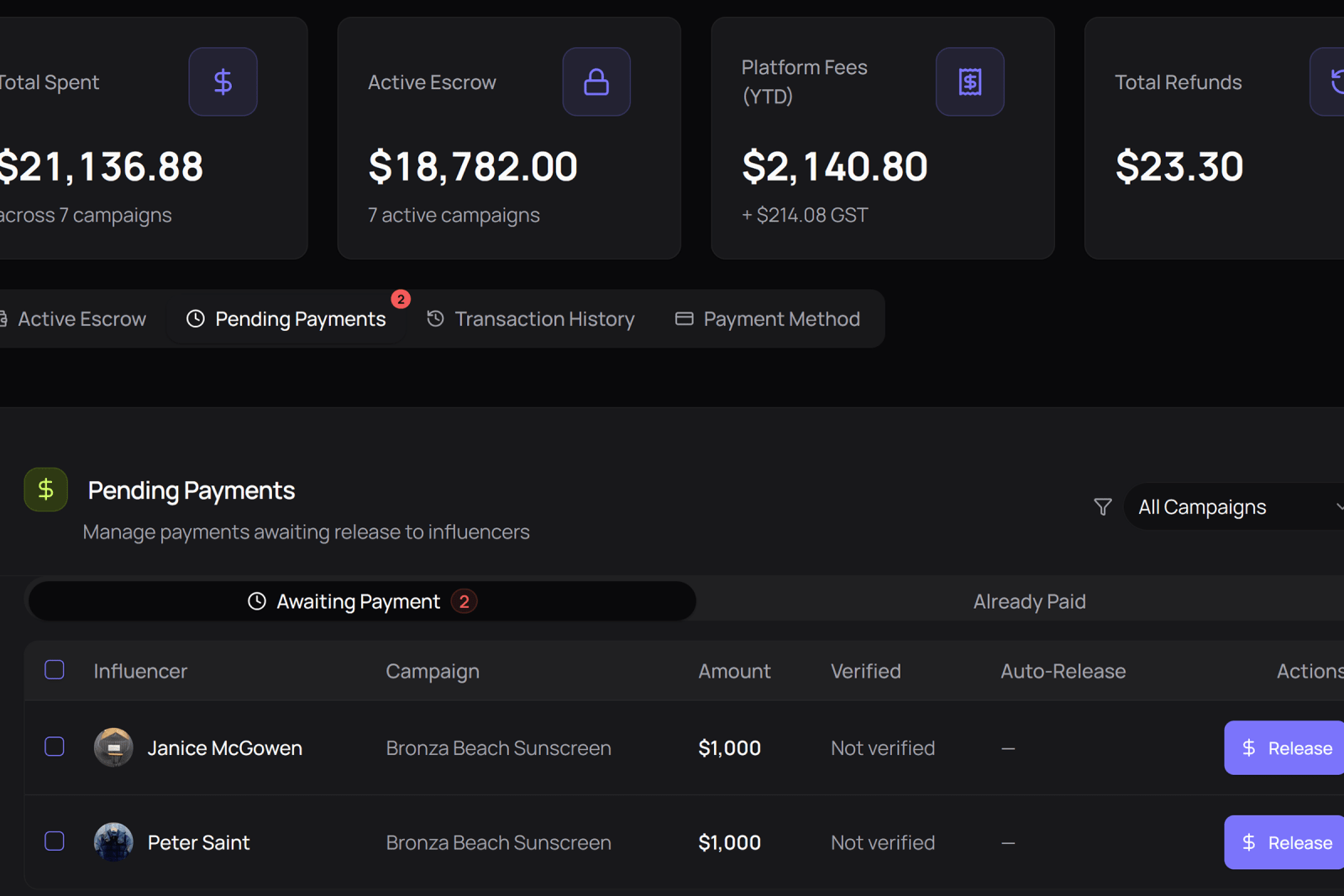
What the rest of the roi-analytics hub covers (read these next)
This pillar is the entry point. Each of the four spokes goes deeper on a piece you’ll need to operationalise the framework above.
Beyond Vanity Metrics: What Brand Managers Actually Need to Report. The five-metric reporting framework in detail, with formulas, AU benchmarks, and a wrap-deck template. Read this if you’re trying to fix what’s in your monthly report rather than redesign the entire programme.
Multi-Touch Attribution for Micro-Influencer Campaigns: A Practical Framework. The attribution stack in implementation detail — model selection, credit waterfall, the four-layer tracking combination, and the failure modes to watch for at 30–100 creator volume. Read this when you’re ready to wire the stack rather than just understand it.
How Much to Pay a Micro-Influencer in Australia: 2026 Rate Card. The denominator side of the ROI equation. Pricing chaos is one of the largest data-pollution sources in influencer maths, and an actual AU rate card is the antidote. Read this before negotiating your next campaign.
The Micro-Influencer ROI Calculator. A working calculator that takes the formulas in this pillar and produces a contribution-profit number for your specific campaign. Read this when you’re sizing the next campaign and want a number you can defend.
For the volume thesis underneath all of this, see the blanket campaign thesis — the operational argument for why running 50 micro creators is structurally better than running one celebrity, and how it changes the entire economics of the programme.
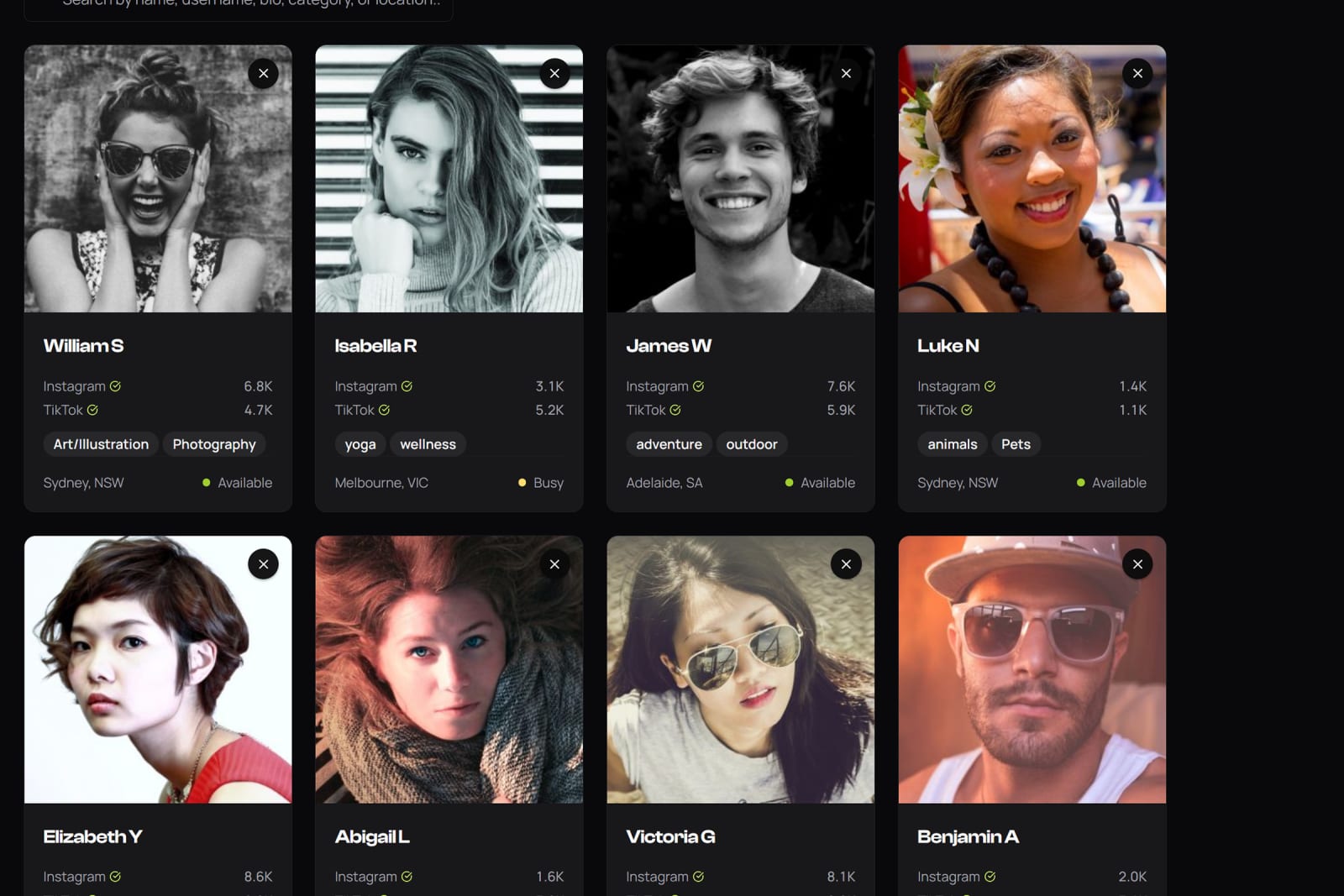
What does a CFO-grade monthly report on an influencer programme actually look like?
Strip everything that isn’t a financial outcome. The Monthly Influencer Report we recommend has five rows.
| Metric | This month | Last month | Plan | Variance |
|---|---|---|---|---|
| Net new customers from creator programme | ||||
| True CAC (fully loaded) | ||||
| Contribution profit (margin × revenue − fees) | ||||
| Breakeven ROAS achieved (yes/no, by cohort) | ||||
| Payback period (months) |
One paragraph of context: what changed and why. One ask: a specific budget action with a number attached. That’s it.
The vanity metrics — likes, impressions, follower growth, engagement rate — go in an appendix or a separate operational dashboard, not on the page leadership reads. If you’re wondering whether your CFO will accept this as a complete report, ask them. The answer is almost always yes; what they reject is the fifteen-page wrap deck full of activity metrics that doesn’t translate to a P&L impact.
Frequently asked questions
What is the average ROI of influencer marketing in Australia in 2026?
There isn’t a defensible single-number answer for Australia. The widely-quoted “$5.78 returned per $1 spent” is recycled from a 2015 US marketer-self-report survey of about 130 respondents and shouldn’t be used in a board paper. The strongest peer-reviewed Australian-relevant estimate is from the IPA’s 2025 Effectiveness Databank: a 3.35× long-term ROI multiplier across 220 econometric campaigns when influencer is included properly.8 Statista forecasts Australian influencer ad spend at about US$589m in 2025.9
How do I calculate ROI for a micro-influencer campaign in AUD?
Use Net Marketing Contribution rather than top-line revenue. The formula: (tracked revenue × gross margin %) − (creator fees + platform fees + product cost + shipping + agency time). Compare against a Breakeven ROAS of 1 ÷ gross margin %. For a brand at 60% gross margin, a campaign needs at least 1.67× ROAS to break even on contribution; below that you’re destroying capital regardless of how good the engagement looked.
What’s the difference between ROAS and ROI for influencer marketing?
ROAS is gross revenue divided by ad spend — it ignores cost of goods, shipping, fulfilment, and platform fees. ROI uses net contribution after those costs. A campaign can show 4× ROAS and lose money if the gross margin is 20%. For micro-influencer programmes where unit economics are tight, always lead with contribution-margin ROI in any wrap deck and treat ROAS as a directional metric.
Should I still use last-click attribution for influencer campaigns?
No. Last-click systematically credits branded search and direct traffic for sales that creator content actually started. Independent research suggests last-click misses up to 80% of influencer-driven conversions because dark social, screenshots, and delayed purchase cycles break the click chain.2 Use position-based attribution as a baseline and graduate to data-driven attribution once you have enough conversion volume to train it.
How do I track influencer ROI now that iOS 17 strips link parameters?
iOS 17+ Link Tracking Prevention strips parameters like gclid and fbclid from links shared in Mail, Messages and Safari Private Browsing.3 The fix is a stack, not a single tool: per-creator promo codes (deterministic), unique UTM tags (still survive most paths), server-side pixel events via Conversions API, and a one-line post-purchase survey question (“Where did you first hear about us?”). Each layer captures what the others miss.
What does the ACCC require for influencer marketing disclosure in Australia?
Under AANA Code of Ethics Section 2.7, advertising must be clearly distinguishable as such — disclosure tags like #ad or #sponsored must be visible in the first frame or upfront in the caption, separate from a hashtag pile.6 The ACCC’s first paid penalty for non-disclosure landed in March 2026 when Photobookshop paid A$39,600 in infringement notices for instructing 107 influencers not to disclose gifted products.5 Compliance is now a direct input into a campaign’s risk-adjusted ROI.
How long does an incrementality test take to run?
A defensible test runs four to eight weeks at minimum. That covers a full purchase cycle for most consumer categories, smooths out weekday volatility, and gives the test enough sample size to detect a 5%–15% lift with 80% statistical power. Geo-holdout designs work for brands that can’t randomise audiences — pick three to four matched Australian metros, withhold influencer activation in half, and compare regional revenue.
What ROI should I expect from a nano-influencer (1k–10k follower) campaign?
The peer-reviewed evidence is unusually strong here. Beichert and colleagues (Journal of Marketing, 2024) studied 1,698 influencers, 2,808 promotional codes and €17m of revenue, and found nano creators (1k followers) generate roughly 5× more revenue per follower than macro creators, with about 20× ROI on a typical paid post around US$50.4 The trade-off is that you need volume — a single nano post is a small signal. A portfolio of 30–50 nano creators is what makes the maths defensible.
Stop measuring vanity. Start measuring contribution.
If you’re running an influencer programme in Australia in 2026 and your wrap deck still leads with impressions, follower counts and that recycled $5.78 stat, the next budget conversation is going to be uncomfortable. The fix isn’t more data — it’s the right five numbers, run at the portfolio level, with an attribution stack that survives privacy, an incrementality test that proves causation, and a disclosure stance that doesn’t carry an A$39,600 footnote.
If you want to see the framework wired into a platform rather than a spreadsheet, this is exactly what we built the brand toolkit to do — measure influencer marketing ROI without chasing screenshots, with fixed creator costs, verified delivery, and per-creator revenue attribution in one report.
Sign up to Mega Donkey and run your next portfolio of micro-influencer campaigns with fixed pricing, escrow release tied to verified delivery, and per-creator data clean enough to put in front of a CFO.
Sources
Footnotes
-
The “$5.78 ROI per $1 spent” figure widely cited in influencer marketing content traces to Tomoson’s 2015 marketer survey (n≈130, US-based, self-report). It is reproduced extensively without methodology disclosure across Influencer Marketing Hub, DataSlayer, Moburst and similar publications. See discussion of zombie statistics in the Influencer Marketing Hub Benchmark Report 2026 critique: https://influencermarketinghub.com/influencer-marketing-benchmark-report/ ↩
-
Layerfive (2026), “Why Last-Click Attribution Is Failing Ecommerce in 2026.” https://layerfive.com/blog/ecommerce-attribution-beyond-last-click/ ↩ ↩2
-
Apple Support, “Link Tracking Protection in iOS 17, iPadOS 17, macOS Sonoma, and Safari 17.” https://support.apple.com/en-au/guide/iphone/iph6f47c2c87/ios ↩ ↩2
-
Beichert, M., Bayerl, A., Goldenberg, J., & Lanz, A. (2024). “Revenue Generation Through Influencer Marketing.” Journal of Marketing, 88(4), 40–63. DOI: https://doi.org/10.1177/00222429231217471 ↩ ↩2
-
Australian Competition and Consumer Commission (March 2026), “PhotobookShop pays penalties for influencer reviews.” https://www.accc.gov.au/media-release/photobookshop-pays-penalties-for-influencer-reviews ↩ ↩2
-
Australian Association of National Advertisers, Code of Ethics Section 2.7 (current text). https://aana.com.au/self-regulation/code-of-ethics/ ↩ ↩2
-
Australian Taxation Office, “Sharing economy reporting regime — information for sellers.” https://www.ato.gov.au/businesses-and-organisations/income-deductions-and-concessions/in-detail/the-sharing-economy-and-tax/sharing-economy-reporting-regime ↩
-
Institute of Practitioners in Advertising (2025), Effectiveness Databank — “ROI of Influence” study covering 220 econometric campaigns. Discussed in the IPA Effectiveness Conference 2025: https://ipa.co.uk/effectiveness/effectiveness-databank/ ↩
-
Statista, “Influencer Advertising — Australia.” https://www.statista.com/outlook/amo/advertising/influencer-advertising/australia ↩
Ready to get started?
Launch your first campaign or join as a creator today.